
Being the best balanced you can be
By Chris Salih on 14 September 2026 in Global, Investment Trusts
The gospel of diversification is simple: vary your exposure and it’s less likely that everything will fail at the same time. Sounds simple on the face of it, but try telling that to someone who has sat on the sidelines and watched technology blow everything else away over the past few years.

A guide to Murray International Trust
In 2026, technology companies are still at the top of the tree, accounting for almost 40% of the S&P 500 by market capitalisation. But it is fair to say their grip has started to loosen. Industrials, energy, financials, materials and smaller companies are increasingly part of the conversation as valuations and economic expectations shift.
Let’s be clear: AI hasn’t gone away. Semiconductor and AI-related companies are still producing some of the strongest returns, and Asian technology earnings have been particularly robust. But the opportunity set is becoming broader and more selective.
Add an unsettled geopolitical backdrop into the mix, and we are seeing greater dispersion between markets, sectors and individual companies. And that matters because dispersion creates opportunity.
That’s the view of Murray International Trust (MYI) co-manager Samantha Fitzpatrick. The trust targets an above-average dividend yield, with long-term growth in dividends and capital ahead of inflation, with the trust consistently offering a dividend yield of 4-5%. The result is a diverse mix of companies, not only from a geographic and sector perspective, but also in terms of the level of dividends paid.
The trust focuses on quality companies and has delivered 21 years of dividend growth*. The trust also has an attractive dividend reserve — roughly 1.2 years of the previous year’s dividend**. The portfolio is also high conviction with roughly 50 equity names and only a couple of long-term fixed income holdings.
Samantha manages the fund with Martin Connaghan. Both took over as co-managers in 2024, replacing industry veteran Bruce Stout.
Why now for this portfolio
- A truly diversified global portfolio in terms of sectors and geographies
- Attractive yield and two decades of dividend growth
- Strong long-term returns for investors
- Move from a 10% discount (2024) to a small premium* reflects confidence that the managers and their approach will continue to perform
- Additional gearing taken out to take advantage of market opportunities
- Has demonstrated strong, downside protection in the past decade
Investment Process
The managers prefer simple businesses that have a strong ability to produce surplus cash and a resilient business model. These could be in any industry. The managers are also prepared to invest anywhere in the world they see value, with MYI’s investment process giving them a buy list of around 900 stocks to choose from. The team’s investment horizon when selecting stocks is at least five years.
The trust also has the ability to invest in fixed income securities, with the process of selecting and monitoring both sovereign and corporate bonds following exactly the same structure and methodology as equities, with the managers using the global investment resources available.
The portfolio has been truly global in nature, with reasonably strong exposure to Asia and emerging markets (currently 26% including Latin America)***. This can lead to substantially different performance to its peers; the trust has struggled when developed markets have outperformed emerging economies – as we’ve seen in periods during the QE era. Its high yield focus also means it has lower exposure to certain growth sectors – such as technology – than some of its peers, which has been a headwind. Ultimately, the process of focusing on defensive businesses which can retain both earnings and dividends, without paying over the odds, has been incredibly successful over the long term, providing stability to investors.
In 2025, MYI’s index benchmark was changed to the MSCI ACWI High Dividend index – this was due to its previous index (FTSE All World) becoming dominated by tech stocks, meaning any risk statistics were becoming less relevant.
“It gives us a far better guide. We can now look at the risk report and have a proper conversation on it, instead of just saying it looks a bit mad with the tech exposure in the FTSE All World,” Samantha says.
Murray International Trust has returned 105% to investors over the past five years (vs. 66.9% for the IT Global Equity Income sector on a share price perspective*. It has also comfortably outperformed its new benchmark over the same period.
Manager’s View
Samantha says the uncertain macroeconomic backdrop has placed an even greater focus on diversification. Not only have the team looked to build an equity portfolio of very different stocks and profiles, but they have also looked to trim their largest individual holding positions from 4.5-5% to 3.5-4%.
She says they have been in the fortunate position of even being able to trim some of the stocks they’ve added to due to weakness in the past 12 months, citing the likes of AbbVie, Johnson & Johnson and Coca Cola.
“We focus on our investment mandate – keeping that covered income goal, which is driving the weight from some of the stocks and just making sure from an income perspective that we meet what investors expect this trust to do,” she says.
Five themes
1. Reducing tech exposure after strong run
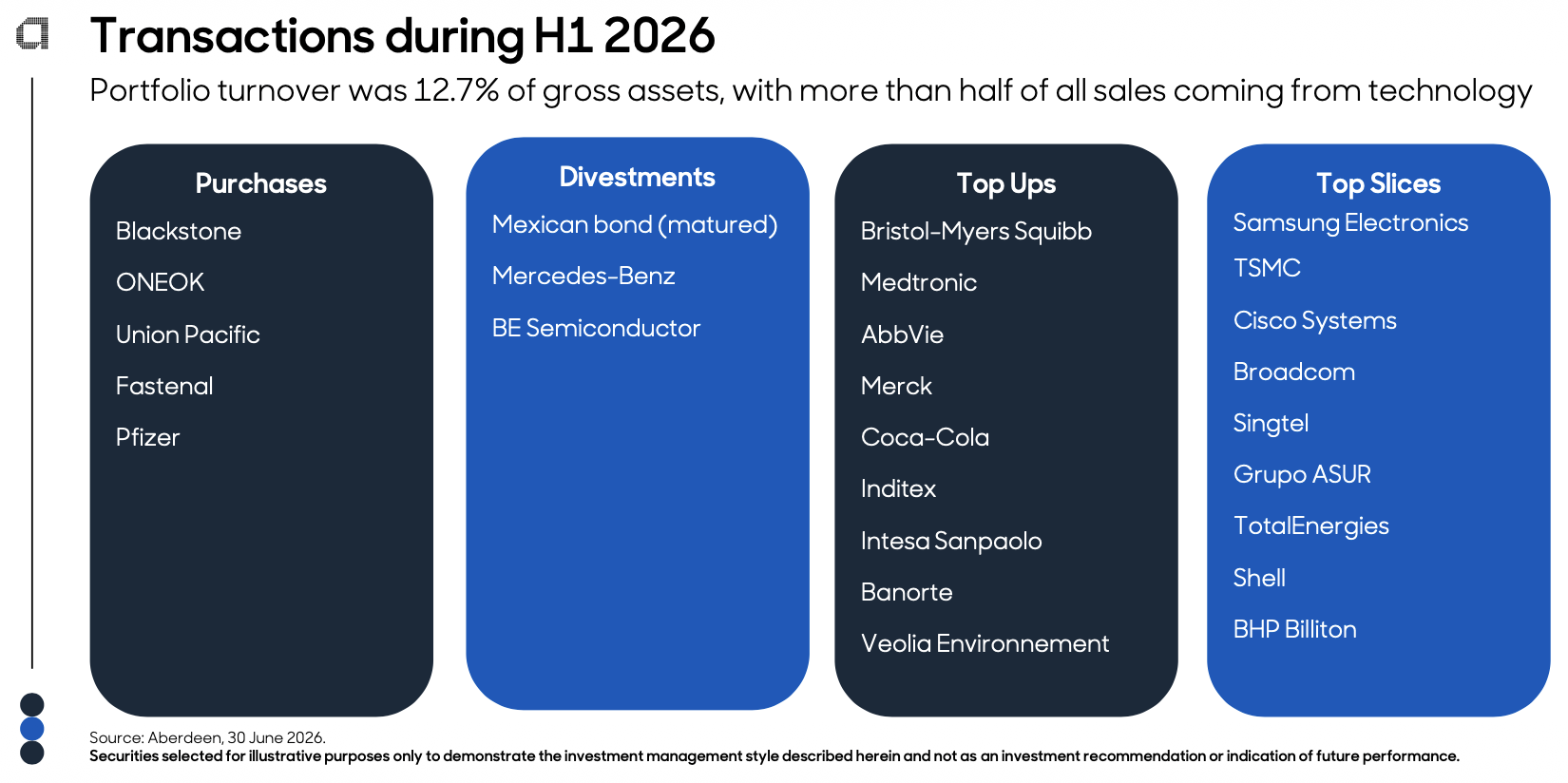
That approach has helped with positioning – some tech stocks have been rising rapidly, and the team have been trimming them aggressively in the first half of 2026 (7% out of tech). They are cautious of the balance between performance and value – but also when they are delivering such a small amount of income to investors
Examples include selling out of BE Semiconductor. Samantha says it has performed extremely well for them in the past four years (including a 4% yield) but adds that it was becoming by far their most expensive stock at 70x trailing P/E. “Even in the first six months of this year it was up 130% – we have to go back to the mandate of the trust and it was stretching to fit in. We kept trimming it down to 1% but eventually it becomes hard to justify with names like TSMC, Samsung and Hon Hai available,” Samantha adds.
Other names were also top-sliced including Samsung (3%), TSMC (2%) and Broadcom and Cisco Systems (both 1%). Samantha says even now these companies’ yields are below 1% and while the issue has not gone away, those smaller holdings mean it has less impact on MYI’s covered dividend position.
Cisco is a good example of the diversification argument for MYI as it gives the trust exposure to networking, cloud infrastructure and the data flows underpinning AI, while also providing a relatively mature, cash-generative business and dividend.
Samsung, BE Semiconductor, TSMC and Cisco Systems represented the four largest contributors to performance for the trust in the first half of 2026.
2. Higher exposure to energy
Having seen a strong run in some of the energy names during the initial stages of the war in the Middle East, the team began to trim a few names, such as Shell and Totale. However, as it became clear there was no swift solution – and that energy prices would be higher for longer – they added once again.
It should be noted that the switch in index benchmark saw the team go from an overweight to an underweight in energy — something they still retain. They have added a new name in the shape of ONEOK, a midstream oil and gas operator that provides gathering, processing, fractionation, transportation, storage and marine export services. Samantha says they funded the position from BHP and that the new holding offers something different in the sector.
She says: “ONEOK is not the most volatile energy company because a lot of its business is contract driven rather than being linked to commodity prices. As time went on, we felt comfortable adding to that space. At 5% it is also an attractive yielder.”
3. US names added to the portfolio
It is often noted that one of MYI’s consistent features is an underweight to US equities. However, Samantha is keen to point out this is not an anti-US approach and more of a function of the strong performance coming from a handful of technology names. This is demonstrated by the fact that all five names added in the first half of the year coming from the world’s largest economy. Lowering their tech exposure has allowed them to look at some lower yielding names in the market and further diversify the portfolio.
In addition to ONEOK, the team have added the following:
- Blackstone: introduced in February 2026 with a 4.5% yield – Samantha says its low valuation is linked to issues with private credit. However, the alternative asset manager is much broader than that, with many other parts of the business performing extremely well.
- Union Pacific: this is a railroad operator yielding 2% which the team believes is a solid, long-term holding from both a quality and diversification perspective.
- Fastenal: At 35x this is now the most expensive stock in the portfolio, but the team believes it is an incredibly impressive business. It is a major distributor of industrial and construction supplies, and the largest fastener distributor in North America.
- Pfizer: A firm which has had its fair share of negative news. However, Samantha says a lot of this is baked into the price and there is also an attractive yield (6%). While it has patent expiry issues, the company is being proactive and Samantha believes the high single-digit multiples are the lowest levels you can expect from the stock.
It should be noted that while MYI now holds 40% in North American equities, it is still a 15.5% underweight versus its index***.
4. EM exposure falls as fixed income holdings drop to just two
Emerging Market (including Latin America) exposure has come down as the team has top-sliced holdings in the likes of TSMC and Samsung. Regional exposure to bonds in this region has also fallen – something which has been a natural change as their bonds mature. By September the team will only have two positions in fixed income – a 2031 South Africa bond and a small UK perpetual bond.
Samantha says: “Lower bond exposure was not a priority – but speaking to shareholders it could be an area of confusion. We did have 14% in emerging market (EM) debt and some investors were wondering what this was. Some of the volatility over the currency over the years has also made some people scared. The changes have been a positive step.”
The team do remain interested in opportunities in the EM space, having bought the likes of Mexican Bank Banorte in 2025 – citing the profitability, capitalisation and asset quality of the business.
5. Healthcare only second to financials as largest sector exposure
Samantha says investors have been dismissive of healthcare over ex-growth, regulatory and patent expiry concerns for several companies – this has allowed them to invest in a number of businesses at incredibly attractive valuations. She says they are confident these businesses will either invest or undergo M&A activity to offset the challenge of patent cliffs.
Top holdings include the likes of AbbVie, Merck and Johnson & Johnson (above 3%). MYI is light on pharma exposure but the team also have the likes of Medtronic for diversification in the sector. Many of these companies were top-ups in the first half of the year.
Other activity
Not every stock has been a success story; a good example is Mercedes, which MYI sold after it paid its annual income in April 2026. Samantha says the stock has been a disappointment despite the 8% dividend yield on offer – something they felt was hard to come by in the luxury space.
She says: “The business was coming out with new models and we liked that it could rotate between traditional, EV and hybrid engines. But we underestimated the competition from China – which has not worked out from a capital perspective. The silver lining is that we did not lose anything given the income generated by the stocks in the two and a half years we held it.”
Performance
Over the past three years, the trust has produced a positive NAV total return of 57.5%, ahead of the 44.6% produced by the Global Equity Income sector*. From a share price perspective, the trust has returned 74.4% (vs. 46.2% for the sector) over three years*.
It should be noted that the portfolio is targeting a relatively strong yield, which lends itself towards having more of a value tilt. MYI has returned 105% to investors over the past five years (vs. 66.9% for the Global Equity Income sector on a share price perspective*. It has also comfortably outperformed its new benchmark over the same period.
Performance can be attributed significantly to stock selection and a willingness to look for companies where valuation and future growth are attractive, rather than simply buying the highest-yielding stocks. Technology has clearly contributed, but so has exposure to the likes of emerging markets.
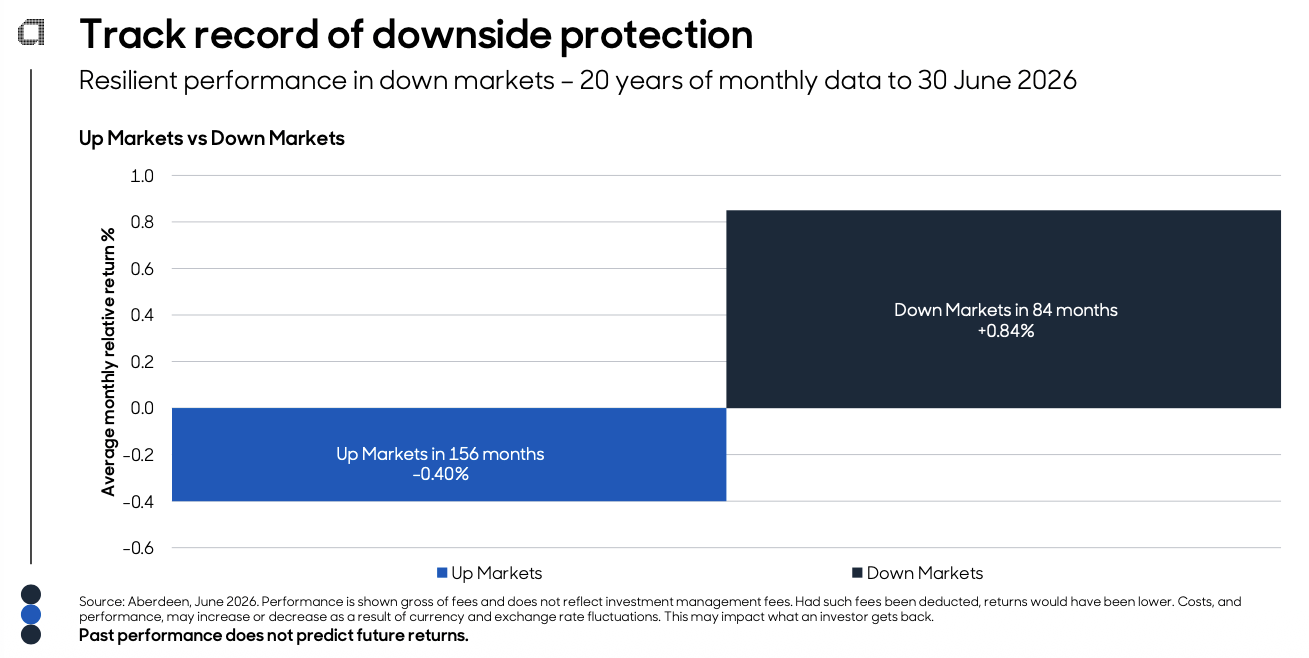
MYI’s focus is on consistency and diversification, meaning it is likely to lag when one theme dominates markets. It has also produced strong returns in down markets in last decade (see chart below)
What else do investors need to know?
- MYI has moved from a double-digit discount in 2024 to a small premium in recent months (currently 1%)* – a reflection of improved investor confidence in performance and consistent dividend returns.
- The team recently increased its gearing from 4% to 8%*, with the board approving a new £100 million multi-currency revolving credit facility (RCF) with Natixis. It is a 360-day facility that automatically rolls over for another 360 days unless either party gives notice. MYI now has £110 million of existing debt plus access to another £100 million of borrowing if it chooses to draw it.
- Ongoing charges stand at 0.5%, broadly in line with the sector average*.
Outlook
MYI has once again demonstrated its ability to navigate a challenging market backdrop by producing diversified and consistent returns in recent times. The managers have taken profits on a number of positions and looked to redeploy those assets into other areas where they see opportunities arising. We see no reason why they cannot repeat their success again.
It is a true diversifier in every sense of the word, be it geography, sector or income profile of the companies they invest in. It is an ideal core holding for investors who have a long-term investment horizon and are looking for income and growth from global markets. We like the fact that the trust focuses on defensive businesses where the managers feel they will be able to retain both earnings and dividends, without paying over the odds.
*Source: AIC, as at 10 September 2026
**Source: Aberdeen Investments, July 2026
***Source: fund factsheet, 31 July 2026
This article is provided for information only. The views of the author and any people quoted are their own and do not constitute financial advice. The content is not intended to be a personal recommendation to buy or sell any fund or trust, or to adopt a particular investment strategy. However, the knowledge that professional analysts have analysed a fund or trust in depth before assigning them a rating can be a valuable additional filter for anyone looking to make their own decisions.
Past performance is not a reliable guide to future returns. Market and exchange-rate movements may cause the value of investments to go down as well as up. Yields will fluctuate and so income from investments is variable and not guaranteed. You may not get back the amount originally invested. Tax treatment depends of your individual circumstances and may be subject to change in the future. If you are unsure about the suitability of any investment you should seek professional advice.
Whilst FundCalibre provides product information, guidance and fund research we cannot know which of these products or funds, if any, are suitable for your particular circumstances and must leave that judgement to you. Before you make any investment decision, make sure you’re comfortable and fully understand the risks. Further information can be found on Elite Rated funds by simply clicking on the name highlighted in the article.
Related insights

Balancing growth and income for long-term returns

The hidden talent in asset management

The case for global equity income in volatile markets