
Boring but profitable — the unsexy side of infrastructure
By Joss Murphy on 18 November 2026 in Specialist investing
How do you fancy putting your money into utility companies, power network providers or toll road owners? They may not be the sexiest investments in the world, but they provide essential services that we simply can’t live without — and, importantly, they can still make you money. Analysts predict that a whopping $151 trillion will be needed over the next 25 years to modernise global infrastructure and meet future generations’ needs*. So, which of these less-than-glamorous areas will be the most lucrative?
But, first, why should you invest in infrastructure?
Infrastructure is essential. None of the ‘luxuries’ we take for granted, such as hot showers, mobile phones and Amazon deliveries, would be possible without it. The multi-billion-dollar companies in this area provide everything from power lines and wastewater plants to airports, railway tracks and 5G masts. Rapid population growth, the green energy transition and artificial intelligence are fuelling demand for their products and services. This could mean annual spending hits $6.9 trillion by 2050*.
The “unsexy” areas of infrastructure
Futuristic airports and smart cities may be the prestige projects that grab headlines, but it’s the more mundane areas that are worth investigating. These businesses provide regular, mission-critical services that keep everything moving. Without them, life would grind to a halt. Their predictable cash flows, long-term contracts, higher barriers to entry and built-in inflation protection make them very attractive to investors.
1. Power grids and networks
Basically, we need a lot more power. Global demand is set to grow by more than 3.5% per year over the rest of this decade, according to the International Energy Agency**. “This is driven by rising industrial use of electricity, the continued uptake of electric vehicles, higher air conditioning use and the expansion of data centres and AI,” it stated. PwC predicts annual spending on power infrastructure will increase from $631 billion in 2024 to $1.1 trillion in 2050, and totalling $25 trillion over the entire period*.
2. Energy transition
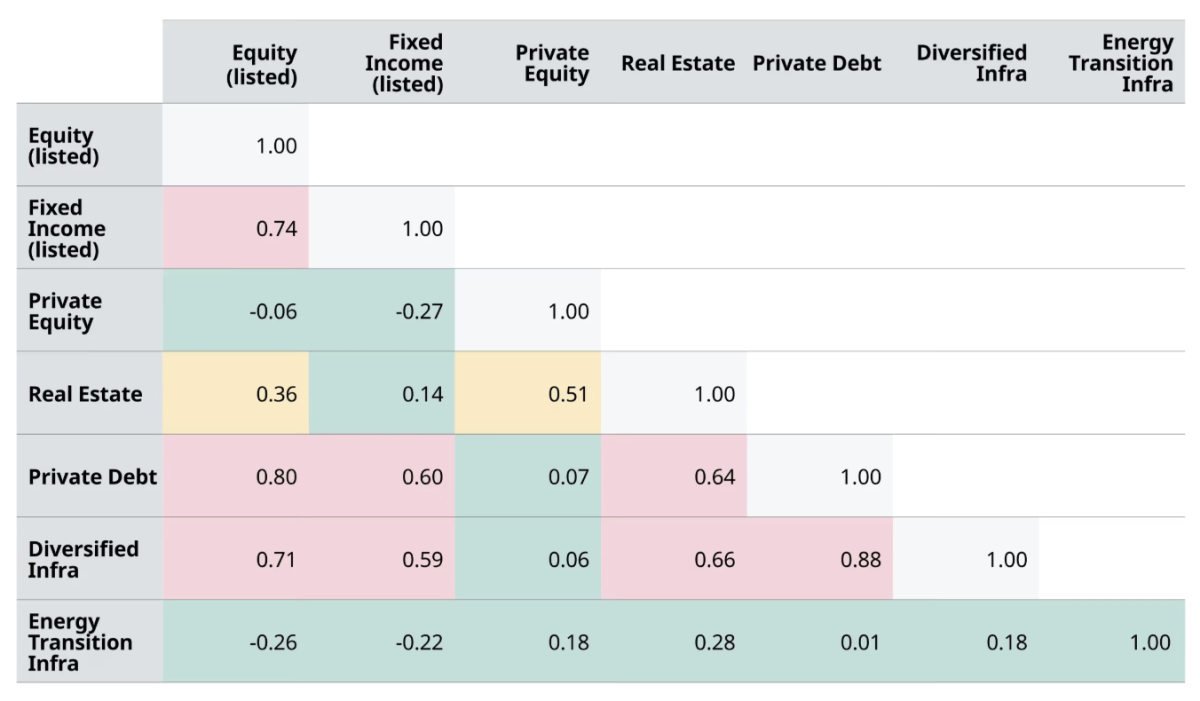
When it comes to the energy transition, everyone thinks of decarbonisation – the process of reducing or eliminating carbon dioxide and other greenhouse gas emissions – but that’s only half the story. Energy security and affordability are also key issues, as the recent geopolitical events and energy price shocks have illustrated. According to Schroders, “the distinct return drivers of energy transition infrastructure create the potential for meaningful portfolio diversification.” The research below shows the year-on-year return corrections with other asset classes***.
3. Transportation and logistics
This is the physical act of moving goods and people. It includes improvements in road, sea, air and rail links around the world. According to PwC, annual spending on rail and airport infrastructure will nearly double from 2024 levels, to $675.3 billion and $154.2 billion respectively, by 2050*. However, this sub-sector includes bridges, tunnels, warehouses, terminals and the various tracking and scheduling tasks along the way.
4. Digital infrastructure
You ignore AI at your peril. Spending on data centres is expected to rise substantially over the coming years, along with investment in crucial components such as chips. This area also includes cloud computing trends, developments in fibre and wireless connectivity, and efforts to tackle cyber risks. PwC predicts total investment in data centre buildings will top $1.5 trillion between 2024 and 2032*. This fast growth will be followed by a focus on efficiency improvements.
Four ways to invest in infrastructure today
Unsurprisingly, there are plenty of dedicated infrastructure funds to help investors put their money into these longer-term projects. Some will give broad, global exposure to a variety of sub-sectors, while others focus on particular countries or more niche areas.
First Sentier Global Listed Infrastructure
This is a recognised leader in listed infrastructure investment and benefits from a strong management team and solid long-term track record. Lead manager Peter Meany is one of the most experienced figures in this field, and we see this portfolio as an alternative way to play the global equity market. The fund is 61% US-focused, although it does have exposure to Canada, Mexico, Japan, China and a raft of European countries^. Electric utilities account for almost a quarter of the portfolio, followed by rail transportation. Union Pacific Corporation^, the US freight railroad firm, is the biggest individual holding.
M&G Global Listed Infrastructure
The aim of this fund is to strike a balance between growth and income from three areas: economic, social, and evolving infrastructure. This means that it can invest in anything from utilities and toll roads to health and civic buildings. If you’re after diversified exposure, then this could hit the mark. Currently, utilities account for 35% of the fund’s exposure, followed by 16% in energy and 15% in transport^^. Three-quarters of the companies are large and mega-caps. The largest individual holding is in Gibson Energy^^. This is a US-based liquids infrastructure company involved in the transportation and marketing of crude oil and natural gas liquids.
TM Gravis UK Infrastructure Income
This diversified fund provides an excellent way to invest in the growing need for UK infrastructure developments and improvements. It also offers a decent yield, which will be attractive to income investors and provide some protection against rising inflation. The fund currently has 39 holdings, many of which are investment trusts that are exposed to different types of infrastructure. Its 10 largest holdings include National Grid^, the UK-based energy firm that manages and maintains the high-voltage electricity and gas transmission networks.
Regnan Sustainable Water and Waste
This is a niche investment fund that focuses on companies that provide exposure to both the water and waste value chains. These are largely under-researched themes. The gap between global water supply and demand is projected to reach 40% by 2030^^^. Solving this issue is therefore a priority. The fund’s largest holdings include United Utilities, which is one of the UK’s largest listed water companies, as well as Republic Services^, which provides non-hazardous waste collection in the US. The fund, which embraces an ESG-integrated process, favours medium-sized businesses with good earnings and clear visibility.

First Sentier Global Listed Infrastructure
Alternatives
M&G Global Listed Infrastructure
Alternatives
TM Gravis UK Infrastructure Income
Alternatives
Regnan Sustainable Water and Waste
Equity
*Source: PwC, 28 April 2026
**Source: IEA, 6 February 2026
***Source: Schroders, 3 September 2026
^Source: fund factsheet, 31 October 2026
^^Source: fund factsheet, 30 September 2026
^^^Source: World Economic Forum, 5 January 2026
This article is provided for information only. The views of the author and any people quoted are their own and do not constitute financial advice. The content is not intended to be a personal recommendation to buy or sell any fund or trust, or to adopt a particular investment strategy. However, the knowledge that professional analysts have analysed a fund or trust in depth before assigning them a rating can be a valuable additional filter for anyone looking to make their own decisions.
Past performance is not a reliable guide to future returns. Market and exchange-rate movements may cause the value of investments to go down as well as up. Yields will fluctuate and so income from investments is variable and not guaranteed. You may not get back the amount originally invested. Tax treatment depends of your individual circumstances and may be subject to change in the future. If you are unsure about the suitability of any investment you should seek professional advice.
Whilst FundCalibre provides product information, guidance and fund research we cannot know which of these products or funds, if any, are suitable for your particular circumstances and must leave that judgement to you. Before you make any investment decision, make sure you’re comfortable and fully understand the risks. Further information can be found on Elite Rated funds by simply clicking on the name highlighted in the article.
Related insights

The global water crisis: four funds investing in solutions

Jellyfish, power grids and a $2.3 trillion opportunity

Six global funds offering six very different ways to invest