
Emerging markets, non-rated bonds and the outlook for high yield
By Darius McDermott on 24 July 2026 in Fixed income
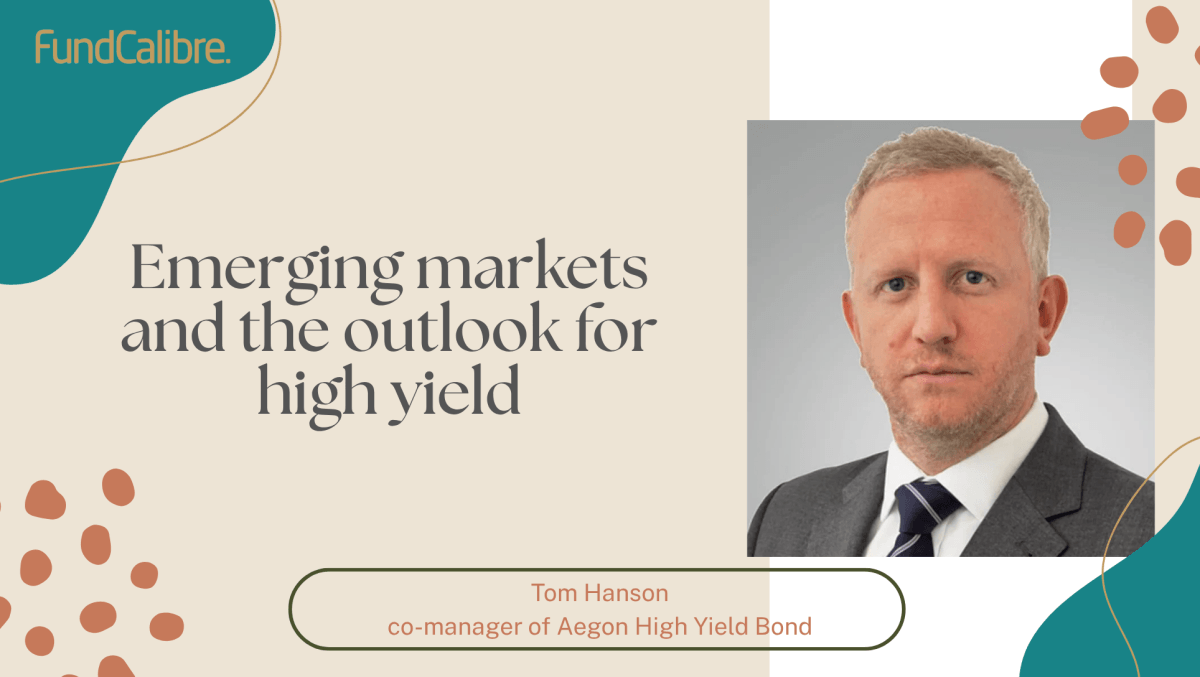
Where are the best opportunities in high yield today? In part two, Tom Hanson, co-manager of the Aegon High Yield Bond fund, explains why the team is investing in emerging markets, the role of non-rated bonds, how they manage risk, and his outlook for the high yield market in the months ahead.
View the transcript
Darius McDermott (DM): I’m Darius McDermott from FundCalibre, and today I’m delighted to be joined by Tom Hanson, co-manager of the Aegon High Yield Bond fund. We’re gonna talk about all things super exciting and high yield. Tom, good morning.
Tom Hanson (TH): Morning.
DM: So let’s look outside the UK. We’ve touched on the US. This is a genuinely global fund and you are allowed a decent allocation in emerging markets, including countries like Brazil, Turkey, Angola. A) firstly, why are you going there? And B) what are the risks and how do you sort, because I know risk is at the, the front of everything you think about. What are those risks and I guess the extra compensation that you’re presumably getting for taking them?
TH: Yeah, well, the theory of hard currency emerging market bonds is the same theory as sterling.
DM: To pick up hard currency means… [TH: Dollars.] Dollars. So you’re not taking any emerging market currency risk in the full fund.
TH: No, so in my world, everything in the emerging market part of the benchmark is dollars. Everything we own is dollars. So, yeah, that’s, to get that clear first and foremost. Look, it’s about opportunity. And I suppose at the heart of what we’re thinking at this point in time is we don’t have much US high yield because we don’t see much opportunity in US high yield. And that’s the biggest, you know, 60%, two thirds of the market. So we’ve got to run a little bit harder and we’ve got to look for other opportunity.
Now, if you look, you know, pound for pound at a lot of these emerging market companies, they trade super cheap, right? They trade even cheaper once you adjust them for their underlying fundamentals. But it’s emerging markets and it carries a notional risk premium and therefore you have to be very, very careful, of course.
But there’s a lot of opportunity there and we are more than compensated, , for those risks by some of the names we own. And so when US high yield isn’t perhaps offering you the opportunities that you’d like, you got to go elsewhere. And so we have found opportunity of non-rated space, which we can talk about, of course, in part of the emerging market.
DM: How, what sort of credit quality do you target — do you demand higher credit quality for that EM premium if you like? Or are you prepared to…
TH: No, we treat them as any other bond. But actually, when you look at it, you look at some of the financials of these companies and you think, well, if, if this weren’t for the fact it’s an EM company, that would probably be, you know – or something like that, right? But it’s not. And again, that brings us back to the, to the theme of opportunity and, you know, you gotta know your onions in high yield. You gotta know what you’re investing in. Rated, non-rated, doesn’t really matter. You have to understand that company from the bottom up as well as the top down, you know, context in which it exists. But yeah, we’ve definitely found a lot of good places to get that.
DM: So, we like to use these videos where we can to explain a little bit about the jargon, the lingo. So let’s just talk about non-rated bonds. Firstly, what that means and then how, again, you’re inputting that opportunity set into the fund.
TH: Yeah. Well, obviously there are three main public credit, credit rating agencies, Moody’s, S&P, Fitch.
DM: And they give a rating based on the quality of your company, the likelihood of you going bust, and being able to pay your coupon. [TH: Exactly.] AAA being the highest.
TH: Yeah. And then the cuts off being BBB- and then everything below BBB- is a high yield company. Irrespective of the yield, by the way, which obviously people get confused, is to do with the rating as opposed to the underlying yield. There is a subset of the market that for whatever reason does not carry one of those public credit ratings. It may be that they…
DM: I mean they cost, apart from anything else.
TH: They cost. They may have decided they don’t want to do that. They may have never had to do it before, so there’s a variety of reasons. But effectively, what it does is it creates an opportunity because not every investor can invest in non-rated bonds. What you have to be aware of is, particularly in the Nordic space, there’s a little bit less liquidity in the norm – I mean, that’s, we’re gonna have [DM: There’s gotta be some payback, right?]
There’s gonna be, there’s gonna be a give. So you will definitely get a valuation pickup, pound for pounds, to be fair, in the non-rated space. Particularly in the Nordic high yields, but you often find the covenants are tighter. You know, your call protection is longer or whatever it might be, or you have maintenance versus incurrence covenants or, you know, all of these things. But there is a liquidity give to a certain extent. And I, but there’s a big difference between less liquid and illiquid. And this is definitely on the less liquid side.
DM: So you’ve mentioned that it’s been a difficult start to the year for high yield. What’s your outlook for the second half of the year in high yield? Is it sort of like a, just an income or coupon type return?
TH: Yeah, I think so, that’s the whole focus of our positioning at this point in time is to, like I said, try and get the best of high yield whilst avoiding the worst. So we want a fund that is very short in duration. So we’re about probably as short in duration terms as we’ve ever been.
DM: So that’s taking less interest rate risk.
TH: Well, yeah, I think about it in spread duration risk. [DM: Right. Right.] High yield should not be considered an interest rate sensitive asset class. No, it’s less spread duration is probably the best way to think about it, but yes. But a bit more spread. And I think what we’re trying to balance here is the fact that spreads are tight, risks are high, but because the technical is so strong in high yield and has been like, there’s no guarantee that spreads re-rack wider, at any point in the immediate future.
And, you know, it’s a very easy mistake to make to perhaps under-risk your fund in what is clearly a tight spread environment with risks without identifying a specific catalyst for that widening, because to be truly, truly defensive in high yield, you will under-yield your benchmark. You’ll be extremely high quality, extremely low duration, which is great as and when a problem occurs, but until that point, you’ll probably be gonna giving up carry.
So what we’ve tried to do is adjust it and get the best of both worlds pay to wait strategy if you like something like that whereby very little CCC exposure. So we’ve lobbed that part off. A lot of short dated single B exposure for the carry and in that way have less duration, more spread, much more income generation, which is the most certain part of the return we can generate.
And try and navigate the environment that way, whilst we wait for whatever developments to happen will, will happen. So yeah, for the rest of the year, the clearly there’s challenges. You’re not paid very well in spread, you’re paid reasonably well in yield, but the technical is strong. And actually credit fundamentals for the core part of high, they’re not that bad. Like many people will say it, but high yield is a far high quality market than it was, you know, when I started 20 plus years ago, right, it used to be a single B dominated market. It’s now a BB dominated market.
A lot of the bad apples have gone to private credit. They don’t sit in our world anymore. So, you know, it has things going for it. It’s just a question of how you navigate it. And, you know, we like to think with our flexible strategy, concentrated strategy, you know, that is a, not a bad place to be.
DM: For more information on the Aegon High Yield Bond fund, please visit fundcalibre.com
This article is provided for information only. The views of the author and any people quoted are their own and do not constitute financial advice. The content is not intended to be a personal recommendation to buy or sell any fund or trust, or to adopt a particular investment strategy. However, the knowledge that professional analysts have analysed a fund or trust in depth before assigning them a rating can be a valuable additional filter for anyone looking to make their own decisions.
Past performance is not a reliable guide to future returns. Market and exchange-rate movements may cause the value of investments to go down as well as up. Yields will fluctuate and so income from investments is variable and not guaranteed. You may not get back the amount originally invested. Tax treatment depends of your individual circumstances and may be subject to change in the future. If you are unsure about the suitability of any investment you should seek professional advice.
Whilst FundCalibre provides product information, guidance and fund research we cannot know which of these products or funds, if any, are suitable for your particular circumstances and must leave that judgement to you. Before you make any investment decision, make sure you’re comfortable and fully understand the risks. Further information can be found on Elite Rated funds by simply clicking on the name highlighted in the article.
Related insights

Is income under pressure?

What’s driving bond funds into 2026?

What investors are thankful for this Thanksgiving