
Finding yield without chasing risk
By Staci West on 19 January 2026 in Fixed income
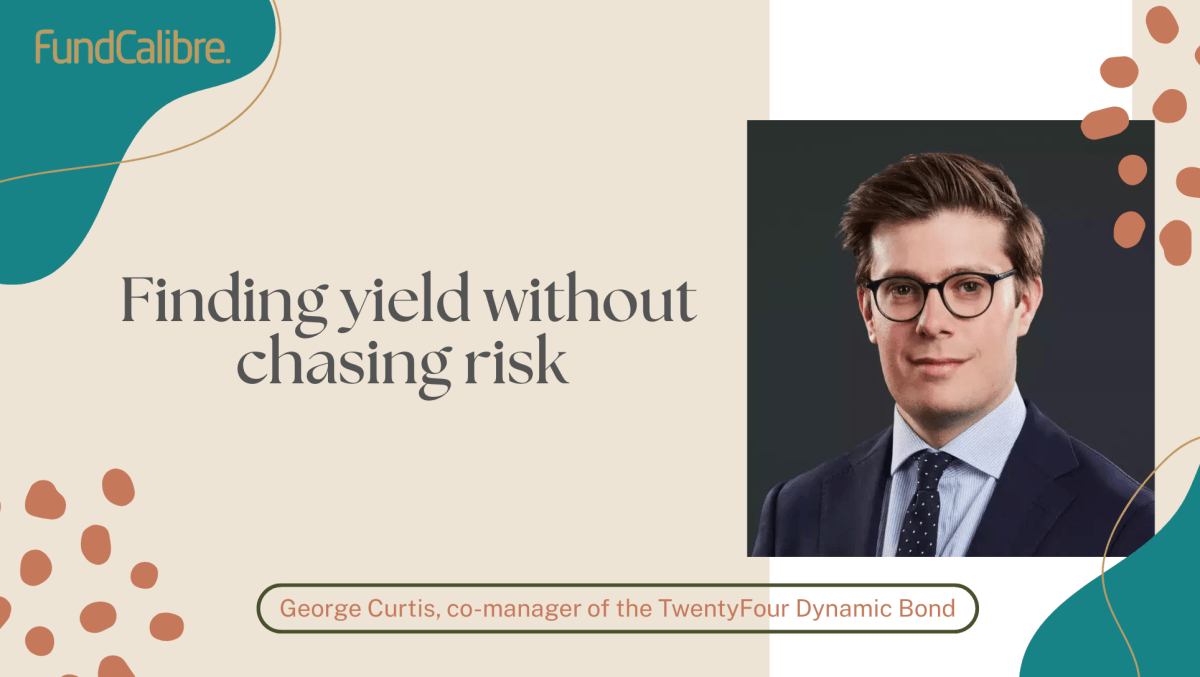
Darius McDermott sits down with George Curtis, co-manager of the TwentyFour Dynamic Bond fund, to discuss the outlook for fixed income markets.
George shares how the team is thinking about interest rates and central bank policy, why duration is being managed cautiously, and where they see the most compelling opportunities in credit today. They also explore the outlook for inflation, the potential lagged impact of tariffs and George’s key themes for the rest of 2026. Throughout, George explains how flexibility, liquidity and disciplined credit selection shape the TwentyFour Dynamic Bond Fund’s approach.
Research the fund today

TwentyFour Dynamic Bond
Fixed Income
View the transcript
Darius McDermott (DM): I’m Darius McDermott from FundCalibre, and today I’m delighted to be joined by George Curtis, who’s one of the co-managers on the TwentyFour Dynamic Bond fund. George, good morning.
George Curtis (GC): Morning Darius.
DM: So I think it would, with any fixed income discussion, we need to talk about rates. I’m sure interest rate movements are a big part of your overall thinking with respect to each individual bond, but also at a portfolio level. So central banks, what are we expecting from the major central banks and what are you sort of thinking about with respect to the duration on the fund?
GC: Yeah, so good question. You know, very high level, we think you know, across the developed market central banks the ECB are done. You know, I think they’re comfortable at the 2% level. But we think probably the Bank of England and the Feds will likely cut a few times. You know, we expect that cutting path to be pretty slow and pretty cautious. Mainly because the balance of risks become more two-sided as they approach neutral, which is this level of interest that neither, you know, stimulates or constraints the economy ultimately the market is largely pricing in the cuts that we are expecting. So we don’t really expect a large rally in duration outside a more material slowdown in growth. We have rates exposure, you know, both for the liquidity it provides and for the protection on that downside scenario if we were to have a recession. But we are not a super long duration, roughly four years in the fund at the moment, which is down from about four and a half at the beginning of Q4 last year.
DM: Okay. So what parts of the market you finding most compelling? I mean, again, the other part of fixed income, really the narrative for the last whatever it is, 12, 18 months are that that spread by the bit that you get paid over the government bond for taking that credit risk has been quite tight. So are there sectors where that spread is attractive or is it country based or where are you seeing that opportunity today?
GC: Yeah, so top down, I think credit in general still offers attractive risk rewards you know, relative to rates and, and relative to other markets, you know, you’ve got strong corporate fundamentals. You’ve got, you know, high oil yields, which gives you good downside protection and you’ve got low volatility.
But as you rightly point out, given the spread environment, you know, we think you have to be highly selective. I think within credit, one of the key things for credit investors this year will be, missing any credit accidents. So we’ve not been tempted to stray too far down the quality spectrum in order to pick up incremental yields. Our favourite sectors are ones in which we can pick up attractive value and couple that with strong, you know, fundamental groundings.
We like structured credit, particularly on the CLO side and across the capital structure, you know, from AAA CLOs and even BB CLOs where we can get strong structural protection, very decent spread pickup relative to the kind of underlying corporate market in a floating rate product. So it doesn’t have that you know, volatility of rates. We also like financials where we’ve seen a wave of upgrades in recent years as central banks have left negative rates, you know, bank balance sheets in Europe are really in the best place that they have ever been. So we like financials both on the bank and the insurance side.
And I suppose, areas that we are more cautious on are probably you know, high yield which is, you know, towards the bottom end of our exposure over the last 10 years. And in particular, you know, lower quality, high yield, B- to CCC rated credit, which is, you know basically a 0% allocation in the fund.
DM: And I think we sort of touched on it, because you said about that higher yield giving, that downside protection, the yield on the funds approximately 6%. And you mentioned the very small, well the smaller allocation to high yield. Where are you managing to get that sort of total yield from?
GC: Yeah, so just over 80% of the portfolio is in credit. Just under 20% is in rates. We are, you know, diversified across the credit sectors, but we are exposed to those most, exposed to those sectors that I just mentioned. So our favoured longs are in, you know, subordinated financials both in banks and insurance and CLOs and I, and again, stress across the capital structure. So we like AAA, CLOs and, and we like BB CLOs. It’s worth saying that that 6% sterling yield is coming, you know, alongside an average rating of BBB+ which is, you know, the highest rating the fund, you know, has ever had.
DM: So better on quality and still a decent yield and quite diversified yield by the sounds of it as well.
GC: Exactly.
DM: So the other question which you have to talk about when we’re talking about fixed income of course, is inflation alongside growth inflation is the other thing that central bankers look at when thinking about rates. But it’s been a, you know, we’re of odd geopolitical time, aren’t we? There’s a lot going on from the US but obviously across the globe, what’s the inflation picture? It’s been a bit sticky. I mean, we were talking about transitory three and four years ago. Well, it’s more than past that juncture. Are you confident on inflation behaving in developed markets so that those rates that you talked about, particularly in the US UK rate cuts might continue?
GC: Yeah, so I think it goes back to the point I made earlier about the balance of risk becoming much more two-sided. You know, the more the central banks cut. You know, for much of the past few months, particularly in the US the conversation really has been around labour markets. You know, we’ve seen weakened on payroll growth, you know, we’ve seen the unemployment rate tick up a bit. But it’s worth saying that inflation is still above target you know, quite meaningfully. So particularly in the UK there are trends that are positive, right on the services side in the US in housing inflation has improved quite markedly, and the expected inflation from tariffs is not really coming through in the numbers at the moment. So I think that you know, has acted as a bit of a tailwind for duration and for the market pricing rates.
And I think, the central banks are are, you know, happy to be seeing that. But I think certainly like we have seen in the last couple of years, we’re gonna go through periods where, you know, inflation is you know, maybe printing slightly stronger than expected. And I think we’re still gonna get volatility in the markets pricing of cuts you know, during those periods. So, you know, I don’t think the inflation bogey you know, has disappeared. And I think it will still remain front of mind for central bankers, but there are some dynamics with inflation that have, I think certainly been positive over the past six to 12 months.
DM: And you touched briefly on tariffs, and God knows we all talk too much about tariffs in 2025, but is there a lagging effect do you think, for that inflation? I mean, again, if you just put into Google what the tariffs mean, well, I think inflation was one of the answers that that came up. Do you think that’s gonna be a lagging effect into 2026 or slightly overplayed?
GC: I think it could be, yeah. I don’t think the market should get, you know, too optimistic on inflation. I know we’ve had a couple of good prints over the past months, both in the UK and and the US but I think part of the lack of reaction and inflation that we’ve seen, you know, from tariffs might just be because producers, corporates have taken some of that margin hit and have taken that margin hit whilst, you know, labour dynamics have been weakening. So maybe, you know, in 2026, if growth is, you know, okay, solid, which is expected to be, and maybe jobs growth improves a bit, maybe corporates start to push a bit of bit more of that price onto onto the consumers. So I definitely think that’s a dynamic that is possible.
I would say that we’ve been surprised by the lack of impact so far. And there have been, you know articles and actually studies, you know, one by the San Francisco Feds recently, which, you know, have alluded to the fact that maybe the inflation pressure from tariff will be lower than people were expecting.
DM: Maybe then as a sort of a last question, would you tell us about the top three themes for the rest of 2026 for the TwentyFour Dynamic Bond fund?
GC: Yeah, so I mean, I talk about the t three themes from a fixed income perspective and then how we are managing that within Dynamic. You know, I think the themes are probably similar ones to 2025, right? I think the market’s been quite focused on ai has been focused on private credit and has been focused on the fiscal side of things. We’ve seen obviously lots of volatility, no longer end of government bond curves with respect to AI we’ve had, and we’ll continue to see a large amount of issuance from the hyperscalers, but also from other issuers. And we’ve seen pretty lofty valuations in equity markets, you know, with a lot of optimism that maybe it doesn’t play out.
So, you know, if credit markets struggle to take down that enormous amount of issuance or if equity market valuations rerate lower because the return on investment from these AI, this AI CapEx is maybe lower than people expect, there could be contagion you know, the fiscal side government spending is too high. And I think maybe that’s become less of a focus in recent months given other dynamics, labor markets and inflation. But that I think will continue to periodically pop up in the coming years.
We’re not expecting a 2022 type sell off in the gilt market, for example. But the net amount being issued to the markets on the government bond side is large, right? You know, 2 trillion plus in the US. And the way that this is manifested and we think will continue to manifest is by, you know, seeing higher risk premium building a higher term premium into government bond curves. And we can still, I think, expect volatility particularly longer end.
And on the private, private credit side, you know, it’s obviously a sector that has grown very quickly in recent years, and maybe there have been some concerns emerging about the quality of the underwriting. I think in some areas not this is, you know, only related to I think a few areas particularly after tricolor and first brands and Jamie Diamond’s comment about “cockroaches in the space”. So in truth we are likely to see more, you know, “cockroaches,” this is the nature of high yield credit investing. You can expect default rates to be more than zero. The historical average in the US high yield market, for example, is above 3%. I think the thing that, will most acutely affect that default rate in the private market will be what happens to the economy, right? And I think that default rate in private market will ultimately be quite correlated to the default rate in the public market.
So from our perspective, Dynamic has no direct exposure to AI, it’s got no direct exposure to private credit. We don’t have an investment where the return on that investment will be determined by the return on equity on AI CapEx. We are not exposed the vagaries of the long end of the government bond, we don’t have any 30-year exposure in any currency. And of course we focus on liquid public credit and we do have a lot of liquidity and we have flexibility.
So I think in this environment in particular, maintaining that flexibility, maintaining that liquidity you know, focus on strong rigorous due diligence from a bottom up perspective, and you’re very well placed to take advantage of any credit volatility if we were to see it.
GC: George, thank you very much. And if you would like to get more information on the TwentyFour Dynamic Bond fund, please do visit fundcalibre.com
This article is provided for information only. The views of the author and any people quoted are their own and do not constitute financial advice. The content is not intended to be a personal recommendation to buy or sell any fund or trust, or to adopt a particular investment strategy. However, the knowledge that professional analysts have analysed a fund or trust in depth before assigning them a rating can be a valuable additional filter for anyone looking to make their own decisions.
Past performance is not a reliable guide to future returns. Market and exchange-rate movements may cause the value of investments to go down as well as up. Yields will fluctuate and so income from investments is variable and not guaranteed. You may not get back the amount originally invested. Tax treatment depends of your individual circumstances and may be subject to change in the future. If you are unsure about the suitability of any investment you should seek professional advice.
Whilst FundCalibre provides product information, guidance and fund research we cannot know which of these products or funds, if any, are suitable for your particular circumstances and must leave that judgement to you. Before you make any investment decision, make sure you’re comfortable and fully understand the risks. Further information can be found on Elite Rated funds by simply clicking on the name highlighted in the article.
Related insights

Five reasons why now could be the right time to revisit bonds

Is income under pressure?

Decision tree: are you ready to invest?