
Income and growth: can investors have both?
By Staci West on 3 June 2026 in Income investing
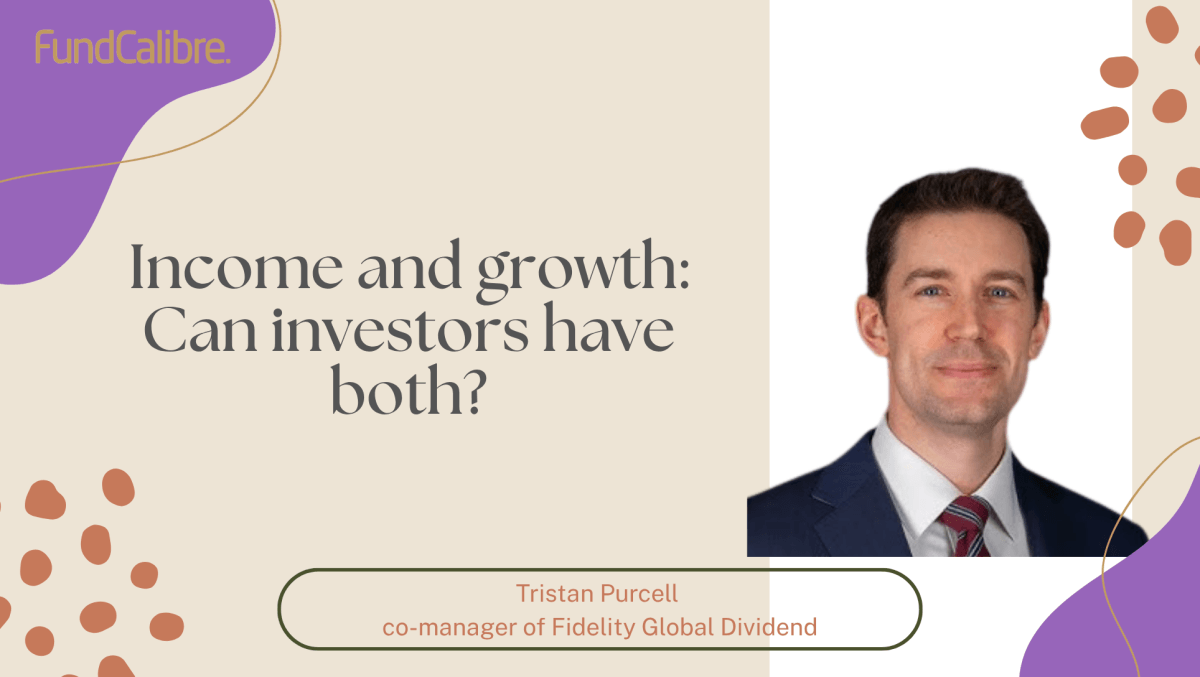
In this interview with Tristan Purcell, co-manager of Fidelity Global Dividend, explores the principles behind a dividend-focused investment strategy that aims to deliver both income and long-term capital growth.
The discussion covers how to identify sustainable dividend payers, avoid dividend traps and assess risk through the lens of capital preservation. We also examine the importance of earnings resilience, valuation discipline and diversification across regions, sectors and business models. The conversation touches on current opportunities in global markets, the role of financial and industrial companies within portfolios and how investors can navigate changing interest rate and inflation environments while maintaining a long-term investment perspective.
View the transcript
Staci West (SW): I am Staci West, and today I’m joined by Tristan Purcell, co-manager of the Fidelity Global Dividend fund. Tristan, thank you for coming to talk to me today.
Tristan Purcell (TP): Morning. Thanks for having me.
SW: Now I wanna start with, you know, the kind of the name of the fund because a lot of investors here dividend investing and they will immediately think of income over growth. So how do you go about balancing the two of those within this fund?
TP: What we set out to achieve is a dividend based total return. So what we mean by that is both the dividend and the capital growth have to be a part of the return that our clients get. So we do aim to provide an attractive yield that’s substantially higher than the broader market, but we are not targeting a yield over everything else.
And one of the most common mistakes you can make in income investing is allocating capital to the highest yielding companies without giving due consideration to the sustainability of that distribution. So companies often have high dividend yields for a reason. You know, the classic example is the mining sector 10 years ago where you could get eight, nine, 10% dividend yields only for those dividends delayed to be cut in half. I think that leads into another sort of key point for the fund, which is we have a more conservative attitude to risk than most.
You can define risk in lots of ways, but the bottom line for us is a potential for permanent capital loss, ie sort of the peak to trough drawdown in a period of market stress. So in those environments, we expect to lose significantly less than the broader market because it’s the compounded series of returns that matters. So if you lose 50% of your capital, you don’t have to gain 50% to get back to break you in, you got to double to get back there.
So we are looking to preserve capital in two ways. First is avoiding companies that have fundamental risk to their long-term cash generation. So we want earnings with very resilient, predictable earnings streams. You can be confident we’ll be there in 10 years time. And then the second point is avoiding overpaying. Because no matter how good the business is, you can still pay too high price. So, you know, Microsoft for example, grew 10% a year for a decade. But if you start at 65 times those earnings in year 2000, then over that decade I think shareholders lost 5% a year.
SW: And then when you’re looking for those companies to invest in what separates, you know, a reliable dividend payer, someone that you’re looking for for this fund versus a potential kind of dividend trap if you like.
TP: So we are looking for companies that generate lots of cash now and can continue to do so rather than hoping for cash to emerge at some point in distant future. We are looking through the lens of earnings visibility and predictability and persistency and the natural, you know, consequence of that is the company can afford the dividend commitment and predictably grow it every year.
So we’ve been able to grow the dividend from the fund every year since inception, including through 2020 during COVID. And a lot of the companies that I mentioned before with like the mining companies that have high yields fall into that trap bucket they often have a dividend commitment from the past when they were much more profitable than now clinging onto and paying out too much of the cash they generate as a dividend.
And if they’re paying out too much of their cash as a dividend, then they’re not, there’s not a lot enough leftover to reinvest in the business, you know, to buy new equipment, to hire more people, to develop more products and so on. So I think the way we look at it is if you aggregate up all the cash flow from all of our companies, we pay out about, well they pay out about half of that is dividends and half of it it’s reinvested. That feels like a decent balance to us.
I think when we’re distinguishing between or trying to distinguish between the traps and the reliable payers we look at the usual metrics, which I’m sure we’ve heard of lots like return on capital margins the level of debt compared to the level of profits and so on. But then we also take account of things that might not appear on the income statements.
So pension liabilities litigation risk, capital allocation by which we mean where management are spending shareholders cash. And I think the most time consuming part is probably the qualitative side. So things like the industry structure, so what the competition might do over the next decade if there’s new technology that might disrupt business model, if the company’s gonna gain market share, what it will do with that. It boost the margins and so on. I think that qualitative analysis, if you do it correctly, that will surface, you know, risks the predictability of those earnings and dividends well ahead of them showing up in the quantitative side.
SW: And then as the name suggests that this fund you can invest kind of globally look across regions, US, Europe, UK, Japan. So where are you currently finding the most attractive kind of opportunities and then maybe why those areas?
TP: So I think if you pick up the factsheets, the numbers that stand out so that we only have 25% of the funds in the US compared to the global benchmark or the global index at around 70%. But I’d stress that’s based on where the companies are actually listed rather than the fundamental exposure of the businesses we own. So if you look at the sales exposure of our companies the portfolio only has around 5% less than the US than the global index. So we’re not materially underweight the US economy.
So by country of listing we do have around, you know, so about a third or 25% in North America around a third in Europe and a third in the rest of the world. And so that’s one third, one third, one third split that’s more in line with global GDP than it was with, you know, the global index weights where the companies are listed in a benchmark, but I’d stress this is all, and it’s not a top down view that creates that we don’t, you know, look at the US, think it’s expensive and therefore decide to invest less there. It often comes up more naturally from the idea generation process. So we’re often looking, often a whole industry will come interesting at one time and you’ll find a cluster of companies that maybe one’s listed in the US maybe one’s listed in Japan, one’s listed in Europe, and you inevitably find that the US listed one trades on a higher multiple were very comparable exposures, very comparable business model and so on. So we just don’t often tend to find the value there.
And I think the other main reason why we have this neutral US economy exposure, but less listed in the US is a lot of the companies that we buy are often the leaders in their industry. They’re often the best in the world at what they do. And if you’re the leader in your industry, you probably are also the leader in the biggest economy in the world, which is the US. So Compass for example, is a catering business listed in the UK, but generates about two thirds of its sales in the US.
SW: You kind of mentioned, you know, it’s not necessarily about maybe geography and looking for these places, but you’re looking at particular sectors or a theme or something like that and working kind of from bottom up when looking into where you want to invest for the fund. So is there something that you feel particularly optimistic about when it comes to maybe a sector or a theme or maybe you’re really cautious about something, kind of on the flip side for let’s say the next year to two years?
TP: Most of the work we do is looking more like five to 10 years ahead to try and understand sort of the range of outcomes over that long period of time. And then establishing whether the value of the company today is conservative compared to that range of outcomes. That said the biggest weights in the fund today by sector are industrials and financials. Turnovers only around 25%. So we don’t make big aggressive pivots, but I think at the margin industrial’s weight has been rising this year and the financials weight has been falling given what I said earlier around the defensiveness and the protection of capital and so on, having our biggest weights in industrials and financials, which are obviously two cyclical sectors, might not chime with what I said earlier, but if you look at what we own within those sectors what we own is, has different characteristics to the sector as a whole.
So within financials, for example, we don’t own any banks which are obviously more economically sensitive, driven by interest rates and so on. Most of our exposure or all of our exposure in financials is to exchanges. So the likes of Deutsche Bank, CME group, and they benefit when people trade, more people trade more when there’s volatility. So they tend to have a nice anti-fragile characteristics.
And then also insurance companies we own. But again, even within insurance, we don’t own life insurers which tend to be swung around by interest rates. We own non-life insurers like Admiral, like the UK car insurer, car insurance, their earnings depend on how often people crash their cars, not something that’s economically sensitive. And then we own things like Munich Re, the reinsurance business who use earnings depend on weather, whether there’s been hurricanes in Florida and so on. Again, not economically sensitive.
So our defensiveness really comes through from finding individual businesses that have the qualities we’re looking for that are defensive in our predictable, and then finding them across as wider range as possible of end markets, geographies, business models and so on.
Because the diversification is important, I think you can create, you can create a defensive portfolio by allocating large amounts just to staples or to utilities or to pharma, you know, classically defensive sectors. But the risk you run if you do that is that the whole sector can still get hit at once by something. So, you know, last year after Trump was elected, you had RFK and tariffs and so on all came in and hit pharma all at the same time. So all of a sudden you, you end up with something hitting all your eggs in one basket.
SW: So both very relevant. But you did mention, you did mention interest rates, you also mentioned no exposure to banks, but as you said, financials is such a big part of the portfolio. So I wanted to kind of go back slightly to that because inflation and interest rates have been major themes for investors for what feels like a number of years now. And so how is that kind of influencing what you want to own? Have you had banks in the past, have you never had exposure to banks? Has it changed? How do you kind of look at what’s happening? As you said you take that five to 10 year view, so how does that affect what you then look for in a business?
TP: Generally we don’t take a sort of top down view to picking companies because often inequities, you know, you might get the macro call, right? You might correctly call inflation or interest rates. And therefore you think, say a bank might go up. But often, you know, even if you’re right about the macro, a lot of other things have to go your way in order for the investment in the individual companies to go well. So, you know, in between macro and company level, maybe something changes in the industry like regulation, something might change in the competitive environment, something like a new entrant might derive or the company themselves might do something, they might pivot into a new market that’s the wrong time or they might do a bad acquisition or something. So we think we’re better off starting at the bottom and working up rather than the other way around. So we try to invest in companies that can perform well across a range of different inflation and interest rates environments, and therefore also the portfolio won’t get swung around by one particular inflation or interest rate or macro outcome.
Historically, the portfolio’s been able to offer quite a lot of resilience in periods of higher inflation, higher interest rates. Like in 2022, I’m gonna look at the track record for that. If I speak about inflation specifically, so our focus on the more predictable and resilient earning streams from our companies that naturally result in companies we own being better able to pass on cost inflation to their customers. So Legrand for example it’s a French industrial business that sells small pieces of electrical equipment largely into buildings. And the person that makes the purchase decision on which light switch to buy for example is the electrician. Whereas a person that has to pay the bill for that light switch is the person that owns the house.
So you or I aren’t gonna notice if the electrician picked a switch that was 50p more expensive than a competitor’s switch. But we are going to notice if the labour bill the electrician charges us is much higher because it takes them longer to install it or the product isn’t designed very well, or worst case scenario, you have to call the electrician back out again in a month’s time because the product’s broken.
SW: Which nobody wants to do.
TP: Yeah, definitely. And then so on interest rates as well we have owned banks in the past, don’t own any at the moment. We do have other companies that will benefit from higher rates like the insurers I mentioned and the exchanges, but then also companies that higher rates will hurt, like those exposed to construction markets. But then the flip side is also true if rates fall, the opposite will happen. So, but I think the whole idea is to own companies that good, look good across a cycle and then you try and diversify away the shorter term swings in macro at the portfolio level.
SW: And then just finally, for someone who might be considering this fund as you know, part of their long-term plan what mindset would you say that they need to have when they’re investing in global equities and a dividend strategy?
TP: When we look at a new business, we try to apply the Ronseal test. So for those people listening who weren’t in the UK 20 years ago watching tv the branding there was, it does what it says on the tin.
So they, if you are, I’ll be mindful that if you’re buying a global equity fund, you are probably thinking that you are getting global diversification across geopolitics, across currencies, across regulatory risk, across one of the governments doing something strange. You probably don’t expect to buy a global fund and have 70-80% of your capital in one country. Now most single country funds have written in their prospectus so they can invest 20% or so outside of the name of the country on the fund. So even if they don’t use it, so you can argue that most global funds today, most tracker funds, for example, look more like a US fund than a global fund.
And then the same is also true for income. You might buy an income fund expecting it to do something different to the growth funds or the passive trackers that you have in your portfolio already. You probably don’t expect your income fund to own the companies that are in those products which are often ones that, you know, don’t pay any dividends or barely pay yield at all.
I think the reason so many, you know, income strategies today own companies that pay barely any dividends and global companies own so much in the US is the benchmark they’re measured against has become so concentrated and they try to stick to that or stick relatively close to it. You can measure the concentration in lots of ways.
I seem to see research through my inbox every day that says, you know, the market’s have only been this concentrated before in the dot-com bubble or in the nifty 50 period or something. I think Japan is the second biggest weight in the global index and that’s only about 5% versus the 70% or so that’s in the US and the biggest single company in the index is Nvidia, which is also 5%. So that gives a sort of a sense of how concentrated we are.
Concentration’s great when the biggest companies are doing well and concentration is increasing. Well, it’s great for passive products at least but it’s not much fun when the opposite is true.
For us, one of the key things we do is we don’t construct the portfolio by beginning with the benchmark and then trying to spread away from it. It’s very much done from a blank sheet of paper. And you know, I tie it back to the Ronseal test I mentioned, you know, the fund is called the Fidelity Global Dividend fund. So we think it’s important that we own companies that span a range of geographies – hence the global – and that everything in the fund pays a decent dividend so that investors are getting what it says on the tin.
SW: Well, on that note, Tristan, thank you very much for joining me today. It’s been really interesting.
TP: My pleasure. Thank you for having me.
SW: And if you’d learn like to learn more about the Fidelity Global Dividend fund, please visit fundcalibre.com
This article is provided for information only. The views of the author and any people quoted are their own and do not constitute financial advice. The content is not intended to be a personal recommendation to buy or sell any fund or trust, or to adopt a particular investment strategy. However, the knowledge that professional analysts have analysed a fund or trust in depth before assigning them a rating can be a valuable additional filter for anyone looking to make their own decisions.
Past performance is not a reliable guide to future returns. Market and exchange-rate movements may cause the value of investments to go down as well as up. Yields will fluctuate and so income from investments is variable and not guaranteed. You may not get back the amount originally invested. Tax treatment depends of your individual circumstances and may be subject to change in the future. If you are unsure about the suitability of any investment you should seek professional advice.
Whilst FundCalibre provides product information, guidance and fund research we cannot know which of these products or funds, if any, are suitable for your particular circumstances and must leave that judgement to you. Before you make any investment decision, make sure you’re comfortable and fully understand the risks. Further information can be found on Elite Rated funds by simply clicking on the name highlighted in the article.
Related insights

Designing a long-term ISA portfolio that works

Building a low-maintenance ISA

What belongs at the heart of your ISA?