
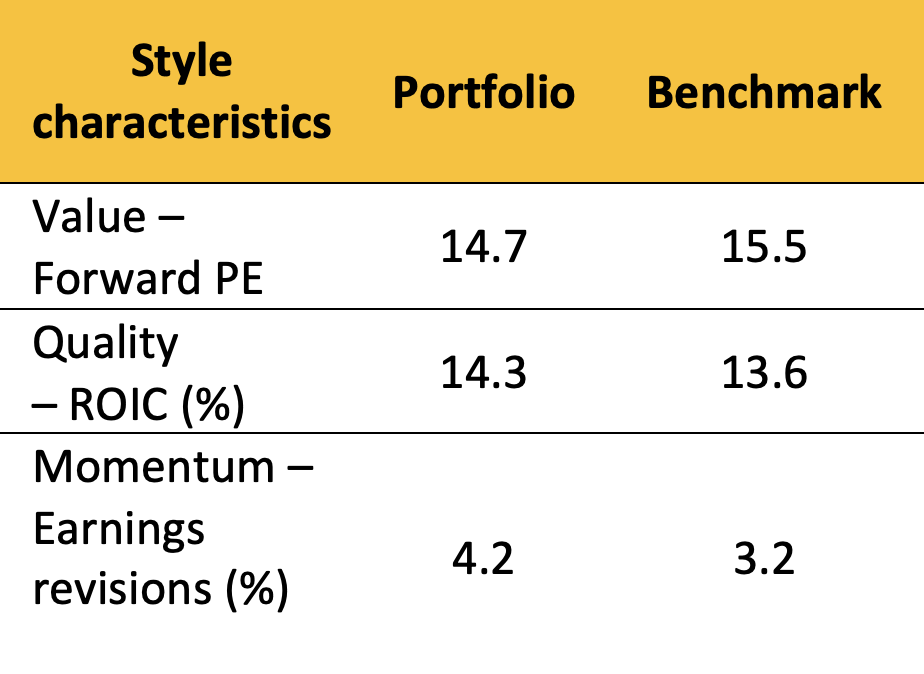
Alexander and the investment team refer to this table as their “proof statement”. Their investment philosophy is based on the belief that companies which are attractively valued relative to the wider market, generate higher returns on invested capital and demonstrate improving operational momentum have the potential to outperform the broader market over the longer term.
Sizing Europe with a balanced approach
By Chris Salih on 17 November 2026 in Europe, Investment Trusts
Buoyed by strong performance in 2025, European equities have continued to deliver in 2026 (returning 10.1% year-to-date)*. But the journey has been far from smooth. Following a particularly strong start, performance has become more subdued as the year has progressed, with geopolitical uncertainty, higher energy prices and concerns around inflation creating periods of volatility.

Although November has brought some renewed optimism, the market is increasingly looking for evidence that corporate earnings growth can justify further gains. However, despite the volatility, European companies continue to offer attractive investment opportunities, supported by established global businesses.
A guide to the JPMorgan European Growth & Income Trust.
JPMorgan European Growth & Income (JEGI) is a core European trust designed to give investors consistent returns across a variety of market conditions. The managers aim to build a portfolio of around 90 stocks by targeting attractively-valued, high-quality businesses with positive momentum. The trust also targets a 4% annual dividend which is paid on a quarterly basis.
Alexander Fitzalan Howard has been senior portfolio manager of the trust since 2006. Alex is a portfolio manager within the JPMorgan international equity group as well as being a member of the core Europe investment team. He is joined on JEGI by co-managers Tim Lewis and Zenah Shuhaiber.
Performance has been very strong, with JEGI returning almost 80% in the past five years, more than four times the average return for their peers in the IT European sector (18.5%)**.
Why now for this portfolio
- A core European portfolio which has consistently demonstrated its ability to produce strong returns in a variety of market conditions
- Long-term performance has been incredibly strong
- JEGI also targets a 4% annual dividend – which is paid on a quarterly basis – however, it should be noted this has no bearing on stock selection by the management team
- Merger with European Opportunities Trust gives JEGI greater scale and lower management fees and ongoing charges
- Has a quality bias
- Discount of almost 5%** gives investors a relatively attractive entry point to a product with exposure to a host of leading European businesses
Investment Process
The process for selecting stocks is bottom-up and combines insights from both fundamental and quantitative research. The portfolio of around 90 stocks is built using JPMorgan’s principles of quality, value and momentum as style considerations.
JPMorgan European Growth & Income has an investment universe of around 1,300 stocks; when selecting companies the team goes through a four-stage process.
The first is style factors: this comes in the shape of quality – whether it is a good business; value – is it attractively valued; and momentum – is the outlook improving? Momentum is arguably the most important of these three style factors as it indicates to management what is happening to earnings revisions and price momentum.
The second is stock-specific considerations: this includes fundamental view revisions, such as news flow; company meetings; and analysing placings and initial public offerings.
The third is ESG considerations, which may positively or negatively impact the investment thesis.
The final factor is the equity failure model which incorporates a wide range of predictors such as quality metrics, capital discipline, governance, ownership, forensic accounting factors, short interest data, and return volatility. This helps identify stocks with high risk of financial distress.
The managers are very risk aware and will have maximum active positions for stocks (+/-2%), sector and country positions (+/-5%). Despite these active positioning constraints, the portfolio can evolve to take advantage of market opportunities, for example it moved further down the market-cap scale in 2025 to invest in the improving outlook for domestic Europe.
JPMorgan European Growth & Income is an all-weather portfolio which is reasonably risk-averse and has several active stock, sector and regional constraints built into the process. The managers expect the portfolio to lag at inflection points in markets and expect it to perform best when there is a trending market (upwards or downwards).
Manager’s View
Market has been unnerved but there are still positives
Alexander says bond yields have seen pretty dramatic changes over the past year – for which he believes there are a number of underlying reasons. The first of these is inflation, citing the problems in Iran and the subsequent impact on energy prices. He says it has to be a concern given how sticky this has been, with no end in sight for the conflict.
Another concern is the significant issuance of debt in the markets. Alexander says part of that is coming from government deficits simply being too big – but there is also more in the corporate sector, particularly the AI CapEx build-out, which is creating competition for funding and pushing yields up.
“I suspect it is a bit of everything but it has unnerved the market. The other thing happening at the moment is, unlike earlier in 2026 when all roads led to AI, the market has started to take a step back from that narrative. Calls for Capex are a part of that but valuations may have run a little ahead of themselves.
Alexander says there is not enough information to determine whether this represents an inflection point in markets” or “more of a hiccup” – adding that the core nature of the product still allows them a good deal of control even when there is underperformance.
Opportunities still abound
Alexander says there are still plenty of opportunities in the market, including AI, where JEGI has exposure to names like ASML – an overweight in the portfolio where the manager points to the order backlog continuing to beat expectations.
Other examples include ABB, which provides control and power systems for data centres. Alexander says this is a classic example of accessing AI growth without paying over the top for the most obvious names. Another is Legrand, which specialises in electrical and digital building infrastructures.
One of the changes the team made quickly in 2026 was to go overweight energy. Additions included Repsol, a global integrated Spanish energy and petrochemical company that operates across oil and gas exploration, refining, chemical production, retail mobility, renewable energy, and commodity risk management.
Alexander says: “We really try not to do top-down macro decisions; it is all about the companies (stockpicking). The interesting thing is the second quarter earnings were great across the market. Two-thirds of companies beat expectations, and year-on-year earnings growth came through at 17% and sales growth was 7%.
The team also hold an overweight to banks, relative to their benchmark, with names like Banco Santander and UniCredit in the top 10 holdings. Alexander says they have not been adding to the banks recently, with the focus shifting to the exchanges, having bought Deutsche Boerse and Euronext.
He says: “Both did not participate in the interest rate-inspired banks rally; they de-rated rapidly and were seen as AI losers. But they have benefitted from the recent volatility.”
Europe is waking up and making changes
Alexander says Europe has started making strides in a number of areas which are improving the outlook for the economy. Examples include the German fiscal stimulus plan – which has bolstered both infrastructure and defence spending. He says Europe has been in a muddle on the defence front having “freeloaded” on US defence expenditure.
It has also offered opportunities on the infrastructure side with names like Schneider Electric and Siemens Energy both strong performers for the portfolio.
“Investors have to always be patient with Europe. One of the reasons why Europe is cheaper than the US market is it is less dynamic. But there are changes coming through,” Alexander adds.
Alexander also says areas like Spain and Greece are also picking up, having been slower to recover following the Global Financial Crisis in 2008. He also says they are becoming more competitive, citing the likes of re-shoring and near-shoring in Eastern Europe.
Portfolio activity
L’Oreal was the biggest top-up in the portfolio in the 12 months to the end of August 2026. Alexander says the team started to see like-for-like sales accelerate with good results in the US, with margins reaching record levels in Q1 and Q2 2026. The stock had also de-rated relative to its history.
Other additions included engineering group Sandvik, which the team bought for two reasons. Firstly, on the back of strong results and secondly for exposure to the copper price. They also introduced a position in Inditex, again on the back of strong results (Zara accounts for about 72% of its revenues). Alexander says sales picked up after a quiet period for the business.
Turning to sales – and the team took the decision to trim SAP after the backlog in the cloud business was not as strong as the market had hoped for – while revenue growth was also slower than expected.
Heidelberg Materials is a stock Alexander says had a big run on performance. However, it has started to look as though volumes were tailing off a bit and they were losing a bit of pricing power. The sale of Compagnie de Saint-Gobain came on the back of poor sales out of the US for roofing tiles.
Performance
This is a core, risk-averse portfolio. As Alexander puts it, “we don’t want to shoot the lights out on the way up, but we don’t want to be carried out on the way down”. Nevertheless, long-term performance has been exceptional, supporting the philosophy of providing an all-weather solution to investors.
Performance over the past five years demonstrates the trust’s abilities, given the raft of different financial environments it encompasses. JEGI has returned 79.4% on a share price total return basis (vs. 18.5% for the average trust in the European sector), and 65.1% from a NAV perspective (19.7% for the sector)**.
For context, the MSCI Europe has returned 50.5% in the same five-year period***, demonstrating the success of the management team as stock pickers within a risk-controlled framework.
What else do investors need to know?
- JEGI is currently operating at a 4.8% discount**. The trust has operated at or slightly above NAV for much of 2025 and early 2026. European equities have experienced periods of volatility during 2026. Concerns around economic growth, inflation, interest rates and geopolitical uncertainty can make investors more cautious about adding to equity positions and may account for the move to a near 5% discount. The board want to keep the discount in single digits and a combination of good flows and strong performance have meant there was no need to introduce share buybacks.
- Gearing is currently 6%**, and typically ranges from 5-8%. The merger with the European Opportunities Trust has meant JEGI’s £50 million fixed rate note was no longer enough to get the top of the trust’s agreed gearing range (given the increased size of the portfolio). The team now uses CFDs as they believe this is the cheapest and most efficient way to add gearing.
- Dividends stood at 4.2% at the end of the last fiscal year. There is no income target set for the fund managers, leaving them free to select stocks regardless of their yield. JEGI is increasing its annual dividend by 8.8% to 5.44p per share for 2026/27, paid quarterly, demonstrating its commitment to delivering a growing and regular income stream for shareholders.
Outlook for Europe
Alexander says Europe is currently in a position where valuations do not stand out, but earnings growth is still coming through.
“We are focused on momentum and for us there are two types. Price – which is something sentiment can affect quickly; and then earnings and operational momentum, which is slightly detached, which means quarterly earnings are a big part of our job,” he says.
This all-weather, multi-cap investment trust has demonstrated its ability to outperform consistently over the long term. The experienced management trio are principally stock pickers and spend a significant amount of time trying to avoid unwanted risk to build this core offering. The dividend policy (backed by strong revenue reserves) is a further attraction for investors looking for a solid European investment vehicle.
*Source: FE Analytics, total returns in pounds sterling, 31 December 2025 to 13 November 2026
**Source: AIC, 13 November 2026
***Source: FE Analytics, total returns in pounds sterling, 13 November 2021 to 13 November 2026
This article is provided for information only. The views of the author and any people quoted are their own and do not constitute financial advice. The content is not intended to be a personal recommendation to buy or sell any fund or trust, or to adopt a particular investment strategy. However, the knowledge that professional analysts have analysed a fund or trust in depth before assigning them a rating can be a valuable additional filter for anyone looking to make their own decisions.
Past performance is not a reliable guide to future returns. Market and exchange-rate movements may cause the value of investments to go down as well as up. Yields will fluctuate and so income from investments is variable and not guaranteed. You may not get back the amount originally invested. Tax treatment depends of your individual circumstances and may be subject to change in the future. If you are unsure about the suitability of any investment you should seek professional advice.
Whilst FundCalibre provides product information, guidance and fund research we cannot know which of these products or funds, if any, are suitable for your particular circumstances and must leave that judgement to you. Before you make any investment decision, make sure you’re comfortable and fully understand the risks. Further information can be found on Elite Rated funds by simply clicking on the name highlighted in the article.
Related insights

Six reasons European equities deserve a place in your portfolio