
AI, war & volatility: how US markets are holding up
By Staci West on 23 March 2026 in US
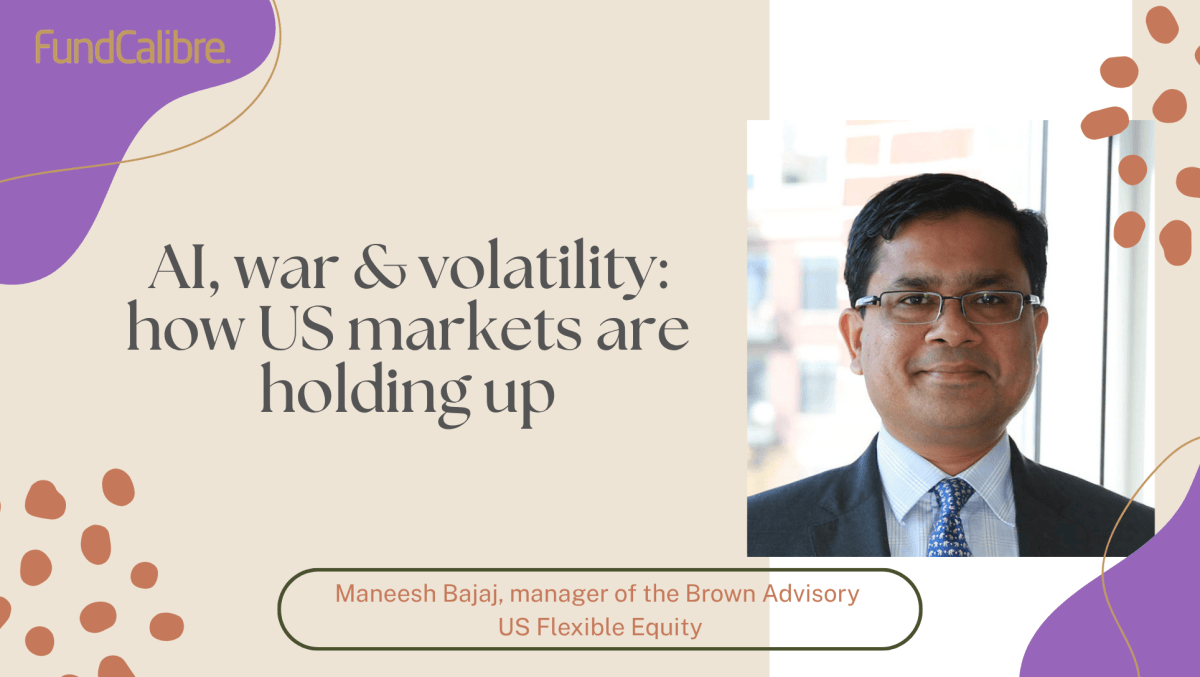
In our recent interview with Maneesh Bajaj, manager of the Brown Advisory US Flexible Equity fund, we discuss how markets are navigating a period of geopolitical tension, economic shocks and rapid technological change.
From the resilience of US equities during global conflict to the long-term impact of AI investment, Maneesh shares insights into how he approaches investing in uncertain times and why staying focused on fundamentals matters more than ever.
View the transcript
Please be aware that the accuracy of machine-generated transcripts, such as those utilised in our video interviews, may fluctuate based on factors like audio quality, subject matter complexity, and individual speaker enunciation. Consequently, these transcripts are unlikely to achieve 100% accuracy. However, it is important to note that, at FundCalibre, we do not consider the correction of automatically-generated captions to be an effective or proportionate use of resources.
Given the inherent limitations of machine-generated transcription, we strongly advise against relying solely on this transcript when consuming our video content. Instead, we encourage you to use the transcript in conjunction with the accompanying video to ensure a more comprehensive and accurate understanding of the topic.
Staci West (SW): I am Staci West, and today I am joined by Maneesh Bajaj, manager of the Brown Advisory US Flexible Equity fund. Thank you for joining me today.
Maneesh Bajaj (MB): Of course, Staci, how are you? Thank you for having me.
SW: Good, thank you. So, you know, the last time that we caught up was quite a while ago. It was about two years ago, and we were looking at what an election might mean and if performance could continue. And it is fair to say that a lot has happened in those two years. [MB: Certainly]
Last year in particular was quite a rollercoaster for investors. 2026 doesn’t seem to be starting any smoother, you know, since the conflict in Iran in February equity markets have been on a steady decline. However, the S&P 500 seems to have fallen the lease. It’s only down about 3% since the start of the conflict when I checked. And the dollar has been strong. So why have US markets been so resilient where others have maybe lagged?
MB: So, Staci you’re so right about 2025. So let’s, you know, just very briefly when we think about 2025 the tariffs was a real shock and it was shock to the global economy. And if you reflect back on 2025, despite this massive shock, the economy proved out to be pretty resilient. And we have had, despite these shocks, companies have been able to grow earnings. And so no wonder the equity markets have done well and equity markets rebounded because the economy has remained strong.
I think related to the war. If the war is not protracted, then the economy is going to prove to be resilient. And when I think about the markets right, US is holding up better for a good reason because US is not a importer, a net importer of energy. In fact, it’s a net exporter of energy only marginally so. But it’s not overly reliant on importing energy. So parts of the world where the markets have suffered more are markets which are importing energy, importing oil, importing natural gas. So US is much more self-reliant.
So clearly the markets have proved to be more resilient. US markets have proved to be more resilient and the markets in some ways are banking that this is not going to be a protracted war, and this is not going to bring down the global economy. And the past wars have taught us that I mean, Ukraine war happened and the global economy has generally proved to be resilient, and that’s what market surprising in right now.
SW: And I mentioned last time we were talking about the upcoming election and we were talking about noise and volatility and all the things that happen when you’re leading up to an election. But how do you factor in, you know, the geopolitics that now we’re talking about conflict and war. Does it change your process at all? I know you are a long-term investor, so does it something that you are factoring in or are you trying to put that to a different side and focus on your focus on your companies?
MB: Yeah, I think the short answer is that we are focusing on the fundamentals of the company. And here again, there’s a lot of uncertainty. There are going to be second order effects, which we do not fully appreciate, but end of the day, we are investing behind businesses that have resilient business models.
And if you reflect over the last five years to your earlier question, a lot has happened, right? We’ve had a period where we had the COVID shock, we went to zero interest rates, then we had high inflation, we had the Ukraine War, and we’ve had a restrictive monetary policy. Yet these businesses have been able to navigate, or most of the businesses have been able, especially in our portfolio, have been able to navigate the environment well. And so our bet is on those kinds of businesses, knowing that it’s very difficult to predict exactly how the world is gonna unfold, right? And so all of a sudden we, here we are, where now we have a war in Middle East, which we certainly hadn’t factored. So our bet is on those businesses that have a resilient business model and be able to navigate a different kind of economic conditions.
SW: And we really can’t talk about the US without talking about technology. It is an extremely large part of the US index, but I actually, I think that you are underweight tech, [MB: Yes] but it’s not it’s not not part of the portfolio. I think it’s about a quarter or 20% around there. [MB: Correct] So what are your views on, you know, this big Mag 7, magnificent seven and this narrative that they’re expensive? Do you agree. [MB: Yeah] That they’re expensive or is there value to be found? Tell me about that.
MB: Yeah, so I think in terms of being expensive, it’s going to be in the eye of the beholder, right? On many metrics. So first of all, these are very, very strong businesses and they have dominant market positions high barriers to entry. These are businesses in Mag 7, which are very, very difficult to replace by competition. So we are in a unique period where many of these mag sevens or the hyperscalers are investing big money on building the AI infrastructure.
So if somebody were to look at their operating earnings and try to value these business and operating earnings on an EPS, they look quite reasonable. But if you were to value these business on free cash flows, where a lot of the free cash flows is going into building the infrastructure, one can make a conclusion that these stocks are expensive.
So, you know, I don’t think that these stocks particularly are expensive. These businesses are dominant. They have their core businesses are very, very profitable. They generate a lot of free cash flows, and it’s so fascinating that these businesses are so big, and yet they continue to grow and compound in value. Microsoft, Amazon, Alphabet, all these businesses are growing double digits. So they’re growing at a pace which is multiple of the economy. So they continue to grow, grow and continue to get bigger.
SW: And you mentioned AI, it’s been such a massive story and continues to to be such a big theme, and we’ve seen, you know, a lot of CapEx spending in AI. Do you think that investors are going to see a return on that investment? Are we getting towards, you know, maybe a bubble territory in your opinion? Or what are those long-term prospects for for AI?
MB: Yeah. you know, the prospects of AI seems to be bright, right? We’ve seen just, I mean, the pace of innovation and the pace of progress has been incredible. This whole technology, at least to the external world has been just three years, a little over three years. And the offering and the capability has dramatically improved.
So for example, software development in the earlier part versus, you know, the last iteration of CLO 4.5, there has been dramatic progress in how software is being developed. For example, software engineers have become very, very productive. And so it is a transformational technology. Right now we are in a phase where lots of investments are going in and you have these hyperscalers putting a lot of money building infrastructure, and each one of them they at least they’re communicating to the external world that their capacity constrained and the capacity constrained because end users and enterprises are investing more behind these technology.
I mean, if you speak to a CEO or a board member, nobody is saying that let us spend less on AI. Most are asking that more money be spent on ai, companies are demanding that their employees better get proficient using AI and use more of AI. So I don’t think anybody is retrenching spending on AI. It continues to grow and grow rapidly.
Now the returns question is very hard to answer that question, right? We are still in the investment phase. As I said profits unclear what kind of returns are gonna be made. Will there be some excesses? I’m sure there will be some excesses, but is it a bubble? Many, many people will argue that it’s not a bubble. And there’s some very, very smart people who will argue that it’s a bubble. We’ll see how this plays out. But the reality is we will not know until we figure out if it was a bubble or not. So it’s only post fact. We will know that it’s a bubble. So we’ll keep our fingers crossed and and hope it’s not a bubble.
SW: Only time will tell.
MB: Only time will tell .
SW: So in addition to technology you do have a significant part of this portfolio in financials. So are we talking banks, financial services, something else? What are the kind of companies and opportunities that you’re seeing in this area of the market?
MB: Yeah, so to your question, you know, we are overweight in financials, but in our strategy, we do not take a top-down view. We aren’t, you know, our process is about making investments on a bottoms up basis. And what that really means is that we are evaluating investment opportunities company by company. And if we find a business, which we really like, if we find a business that is going to grow in value, well into the future well-managed business, and more importantly, if we like the price, then we become investors.
So our portfolio is constructed in our bottoms up where so you are right. Our weight in financials is higher relative to the S&P 500. However, our investments in this sector are very, very diverse. And so we have payment networks, we have Visa and MasterCard, and one can, you know, ask a legitimate question whether these are financials or they’re a technology company, right?
They’re network, they aren’t lending money, they’re not insurance company, they’re not in capital markets. All they’re doing is transferring electrons from the point of sales to the bank. So these businesses are categorised as financial services, but they’re really not in traditional way of thinking. Now, in our portfolio, we also have banks, we also have insurance companies we also have Berkshire Hathaway, which is characterised as a financial company. It does have a big insurance business, but it also have an industrial business and energy business. We also have exposure to alternatives. We have an investment in KKR, so it’s a very diverse set of companies, diverse set of portfolio, and each one of the companies we own are leaders in the segment they compete in. So we like the investments we have in financials and we do think that we will be able to our, our clients will benefit from these investments in these companies.
SW: And then finally, we are coming up to tax end here in the UK. So for those watching who might be feeling a little bit nervous with the current state of markets, the volatility and you know, things we talked about at the top of this interview what is the key message that you would just leave them with when it comes to, to investing right now?
MB: I think stay the course. And if you look at history, the best thing to be doing is to stay invested. There is going to be volatility, there is gonna be fear in the marketplace. There are gonna be opportunities. And when there is fear in the marketplace, generally speaking, that’s the best time to add or stay invested. It’s very, very difficult to time the market. It’s very difficult to time the top and very difficult to time the bottom. So you know I think equities is a great way to create long term wealth. And so, you know, be diversified and stay invested is what I’d say to you. And, of course, you know, the market is volatile, the world is volatile, but generally humans continue to make progress and equity returns in the past at least, have been superior to other asset classes. So well stay invested.
SW: Maneesh, thank you very much for joining me today. It’s been incredibly insightful.
MB: Thank you, Staci. Thank you for having me.
SW: And to learn more about the Brown Advisory US Flexible Equity fund, please visit fundcalibre.com
This article is provided for information only. The views of the author and any people quoted are their own and do not constitute financial advice. The content is not intended to be a personal recommendation to buy or sell any fund or trust, or to adopt a particular investment strategy. However, the knowledge that professional analysts have analysed a fund or trust in depth before assigning them a rating can be a valuable additional filter for anyone looking to make their own decisions.
Past performance is not a reliable guide to future returns. Market and exchange-rate movements may cause the value of investments to go down as well as up. Yields will fluctuate and so income from investments is variable and not guaranteed. You may not get back the amount originally invested. Tax treatment depends of your individual circumstances and may be subject to change in the future. If you are unsure about the suitability of any investment you should seek professional advice.
Whilst FundCalibre provides product information, guidance and fund research we cannot know which of these products or funds, if any, are suitable for your particular circumstances and must leave that judgement to you. Before you make any investment decision, make sure you’re comfortable and fully understand the risks. Further information can be found on Elite Rated funds by simply clicking on the name highlighted in the article.
Related insights

The overlooked corners of the US market

Entering a new phase for US equities

What investors should watch in the coming months