IFSL Wise Multi-Asset Income
This fund aims to provide income and capital growth over the long term. It has the ability to invest directly or indirectly across multiple asset classes including equities, fixed income, infrastructure, property and private equity. The portfolio has a value focus, meaning it has a preference for out-of-favour areas of the market. This is often taken advantage of through the investment trust structure, which allows the team to invest in funds at discounts to their net asset value. Turnover of underlying holdings in the portfolio tends to be very low.

Quick Access
Our Opinion
We like the team’s straightforward process and focus on managers with a simple, yet disciplined investment approach. This is an interesting alternative for those looking for an attractive income. The portfolio is high conviction and often uses investment trusts to tap into value opportunities, by accessing sectors and regions which are unfashionable (through portfolios which are at a discount to their asset value). Alternative investments also account for a reasonable portion of the portfolio, giving investors a more diversified income stream.
Fund Managers

Philip Matthews, Fund manager
Philip Matthews joined the Wise Funds team in September 2018 as co-portfolio manager. After graduating from Cambridge, Philip began his fund management career at Jupiter in 1999, spending 13 years managing retail and institutional equity portfolios. His portfolios focussed on income generation and he has experience investing in UK companies across the market-cap spectrum. In 2013 he joined Schroders, where he managed their UK Alpha Plus portfolio and UK Growth Investment Trust.

Vincent Ropers, Fund manager
Vincent Ropers joined the Wise Funds team as co-portfolio manager in April 2017. He started his career in 2004 and brings experience in multi-asset research and portfolio management, previously at Goldman Sachs, Fidelity International and Ignis Asset Management, which became Standard Life Investments. He is a graduate from ESCP Europe in Paris and holds the Investment Management Certificate.
Risk
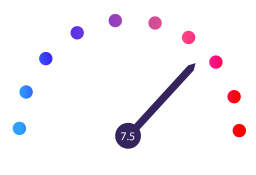
The fund is benchmark agnostic and the team is happy to take concentrated positions when it has strong conviction in a particular asset class, theme or manager. However, the managers will look to express their views in a risk-controlled manner, which naturally leads to diversification. Liquidity risk is assessed monthly on both an internal and external basis.
As a multi-asset vehicle, the fund has around 30-60 underlying holdings to offer diversification. The team focuses on high-quality funds and investment trusts investing in out-of-favour areas, which means performance can take longer to come through.
Company Description

Wise Funds is an employee-owned company, established in 1992 and based in West Oxfordshire. Wise Funds is an investment management business specialising in multi-asset portfolios offering both a growth and income fund to investors.
Talking Factsheet
 IFSL Wise Multi-Asset Income
Philip Matthews
Investment process
IFSL Wise Multi-Asset Income can invest directly or indirectly across multiple asset classes including equities, fixed income, infrastructure, property and private equity.
The team aims to invest in these funds or investment trusts at times when their prices are significantly below what it estimates are their fair values. The managers also believe they can serve their shareholders best by adopting the widest possible investment remit, so that when certain asset classes become dangerously expensive, they have the best chance of finding value in others.
Philip and Vincent start the investment process by combining bottom-up research with a macro overlay. The bottom-up focus looks at manager research, backdrop for the asset class, market knowledge, industry trends, competitor analysis and valuation focus. Meanwhile, the macro covers broader themes like politics, events, sentiment, inflation, valuation and growth.
The next stage covers market technicals. The fund invests in public vehicles (funds, investment trusts or equities) all of which fluctuate in price. These fluctuations are both challenges and opportunities where the managers believe they can add value over time.
Although the fund has no strong style bias, it does lean towards value. When focusing on fund selection, the team specifically looks for companies with a clear investment philosophy and repeatable investment process. As mentioned, the team wants to target managers at times when their sectors are unfashionable and their styles are out of favour, ideally through closed-ended funds at discounts to their asset values, as they feel this is the best route to achieving their funds’ objectives over time.
The fund has a small allocation to direct equities but is not actively look to increase this.
The fund targets an annual income in excess of 3%, and income and capital growth (after income distributions) at least in line with the Consumer Price Index (CPI), over rolling periods of 5 years.
The final portfolio typically holds 30-60 companies.
Risk
The fund is benchmark agnostic and the team is happy to take concentrated positions when it has strong conviction in a particular asset class, theme or manager. However, the managers will look to express their views in a risk-controlled manner, which naturally leads to diversification. Liquidity risk is assessed monthly on both an internal and external basis.
As a multi-asset vehicle, the fund has around 30-60 underlying holdings to offer diversification. The team focuses on high-quality funds and investment trusts investing in out-of-favour areas, which means performance can take longer to come through.
ESG
ESG - Limited
The team at Wise believes the analysis of ESG factors not only opens up potential investment opportunities but also highlights potential risks, both of which should lead to better investment outcomes. The team actively discusses these factors with its investment managers and expects them to do the same with their underlying holdings. This policy is applied across all asset classes the team invests in, whether held directly or indirectly via third-party funds.
Whilst the team invests in funds for which improving corporate governance forms part of their investment strategy, or which invest into sectors that create a positive societal or economic impact, the fund itself does not explicitly adopt non-financial considerations, such as an ethical policy or specific exclusions.
The team reads research and annual reports, and holds meetings with executive management teams, board members and fund managers to give it a rounded view of the particular ESG issues facing direct or underlying holdings. The team also favours the investment trust structure for their holdings – where it believes there is strong corporate governance oversight provided by an independent board. It is also active on voting resolutions.
Related Insights

Four investment trust sectors trading cheaply

A £1,000 windfall: spend it, save it or invest it?

When to save, when to invest and how to know the difference
The information, data, analyses, and opinions contained herein (1) include the proprietary information of FundCalibre, (2) may not be copied or redistributed without prior permission, (3) do not constitute investment advice offered by FundCalibre, (4) are provided solely for informational purposes and therefore are not an offer to buy or sell a fund, and (5) are not warranted to be correct, complete, or accurate. FundCalibre shall not be responsible for any trading decisions, damages, or other losses resulting from, or related to, this information, data, analyses, or opinions or their use. The Elite Fund rating is subjective in nature and reflects FundCalibre’s current expectations of future events/behaviour as they relate to a particular fund. Because such events/behaviour may turn out to be different than expected, FundCalibre does not guarantee that a fund will perform in line with its FundCalibre benchmark. Likewise, the Elite Fund rating should not be seen as any sort of guarantee or assessment of the creditworthiness of a fund nor of its underlying securities and should not be used as the sole basis for making any investment decision. FundCalibre disclaims any responsibility for trading decisions, damages or other losses resulting from any use of the Elite Fund rating. All performance data, as well as fund size, OCF, AMC, annual income (historic), share price discount or premium, is sourced directly from FE Analytics, and will change periodically.