
FTSE 100 hits 8,000 – forget the number, it’s still cheap!

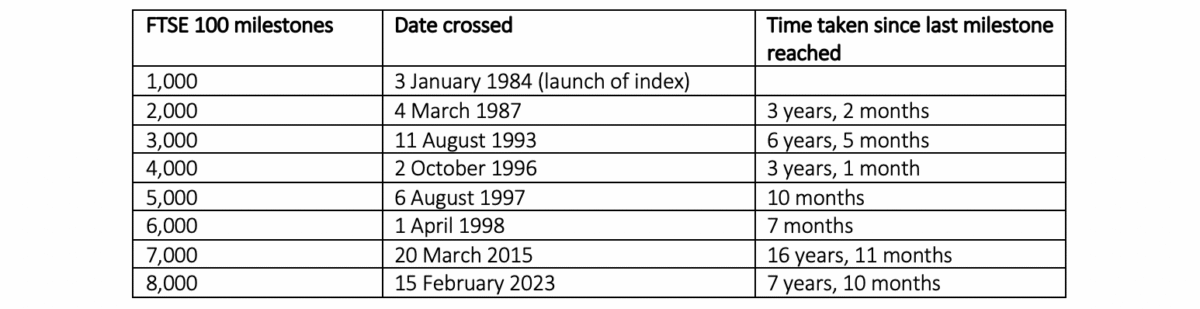
Last week we saw the FTSE 100 cross the 8,000 barrier for the first time in its history. But that does not mean the blue chip index is now on the expensive side – if anything, it is quite the opposite, according to Darius McDermott, managing director of FundCalibre.
What is the FTSE 100?
The FTSE 100 is made up of the UK’s largest 100 companies and is the most widely used barometer of the health of the UK stock market.
When the index falls, it makes the headlines because the share prices of the UK’s largest companies are falling on aggregate and investors are losing money. When it rises it makes the headlines because those share prices are rising, and investors are making money.
FTSE 100 milestones
What does the new record tell us about the FTSE 100?
At first glance, the new record comes at a seemingly strange time. There are widespread fears about the health of the UK economy, with the International Monetary Fund saying it will be the only major economy in the world to enter a recession in 2023.
The pound is also falling against the dollar after a bigger than expected drop in UK inflation in January – a move which could see the Bank of England potentially end interest rate hikes sooner rather than later.
But because many FTSE 100 companies generate a significant proportion of their revenues from abroad, a weaker pound actually offers support for earnings within the FTSE 100 index.
“At a price-to-earnings level (which is a broad level of valuation), the FTSE 100 index is cheaper than it was three and five years ago, regardless of the headline numbers we are currently seeing,” commented Darius.
“It’s also important to remember that a handful of stocks in the mining and energy sector – aided by rising energy prices – have driven the FTSE to these record highs.
I would also like to note the FTSE 100’s exposure to other “old economy” sectors, like banks and insurers, has given it an additional degree of protection at a time when many growth sectors, such as technology, have suffered badly,” he said.
Will further gains be made?
The narrow level of performance within the FTSE 100 is highlighted by the fact that the top 20 companies in the index saw their share price rise by almost 16 per cent in 2022, while the remaining 80 fell over 17 per cent*.
Darius continued, “Ever since Brexit back in 2016, the UK has been largely shunned by overseas and domestic investors alike – when this changes I’d argue we can expect further gains.
“We must also remember the index is the most mature dividend paying market in the world – with many of these stocks remaining attractive in the current economic backdrop,” he concluded.
Elite Rated funds investing in FTSE 100 companies
A number of Elite Rated funds and trusts invest in FTSE 100 companies. Here are three examples:
The City of London Investment Trust
Launched in 1891, The City of London Investment Trust is one of the longest-running investment trusts in the UK. It aims to provide growth in income and capital by investing predominantly in larger UK companies with international exposure – its top ten holdings are all currently FTSE 100 listed**. The trust has also increased its dividend payment every year for the past 56 years and is very good value: it charges just 0.325% per annum of net assets under management.
Rathbone Income
This fund gives investors exposure to a concentrated portfolio of companies with high quality and visible earnings. The manager is unconstrained in terms of sector weightings and is able to fully express his market views with the portfolio positioning. The fund usually consists of between 30 and 50 holdings and currently has 66.64% of assets invested in FTSE 100 companies**.
Jupiter UK Special Situations
Managed with a distinct contrarian and value-based approach, Jupiter UK Special Situations fund offers investors access to a reasonably diversified portfolio of large- and mid-cap UK stocks. The manager, Ben Whitmore, is hugely experienced and has had considerable success in running this type of mandate. The fund currently has 74.8% of assets invested in larger companies**.
*Source: Janus Henderson, UK equities – reasons for optimism in 2023
**Source: fund factsheet, 31 January 2023
Photo by Ankush Minda on Unsplash
This article is provided for information only. The views of the author and any people quoted are their own and do not constitute financial advice. The content is not intended to be a personal recommendation to buy or sell any fund or trust, or to adopt a particular investment strategy. However, the knowledge that professional analysts have analysed a fund or trust in depth before assigning them a rating can be a valuable additional filter for anyone looking to make their own decisions.
Past performance is not a reliable guide to future returns. Market and exchange-rate movements may cause the value of investments to go down as well as up. Yields will fluctuate and so income from investments is variable and not guaranteed. You may not get back the amount originally invested. Tax treatment depends of your individual circumstances and may be subject to change in the future. If you are unsure about the suitability of any investment you should seek professional advice.
Whilst FundCalibre provides product information, guidance and fund research we cannot know which of these products or funds, if any, are suitable for your particular circumstances and must leave that judgement to you. Before you make any investment decision, make sure you’re comfortable and fully understand the risks. Further information can be found on Elite Rated funds by simply clicking on the name highlighted in the article.
Related insights

Balancing growth and income for long-term returns

The companies profiting from Mother’s Day

375. From Budget noise to market opportunity